|
 |
 |
 |
 |
 |
 |
 |
 |

 |
Successful Flight Test Of Initial NLV Development Vehicle
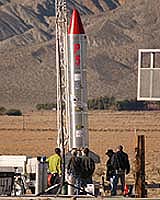
Long Beach CA (SPX) Dec 15, 2004 A joint industry - academic team achieved an important milestone on Saturday, 04 December 2004, when they conducted their initial launch and recovery of a full-scale flight development unit for a proposed Nanosat Launch Vehicle (NLV). The NLV is intended to provide dedicated, primary launch services to small satellite developers and operators whose spacecraft have a mass of 10 kg or less. Working together through the California Launch Vehicle Education Initiative (CALVEIN), Garvey Spacecraft Corporation (GSC) and California State University, Long Beach (CSULB) successfully launched and then recovered their Prospector 5 vehicle by parachute. The team conducted these operations at the Mojave Test Area that is owned and operated by the Reaction Research Society (RRS). The Prospector 5 is an early, low-fidelity version of the NLV first stage. The primary objective for this flight test was the demonstration that the CALVEIN team could develop and handle a vehicle of this scale. In addition, a "fincam" payload provided by a member of the CSULB student team transmitted on-board video of the first several seconds of flight, typifying the kind of academic experiments that are envisioned for operational NLV missions. Also noteworthy with respect to other small launch vehicle development programs that are focusing on "responsive space launch" was that all field operations for the Prospector 5 flight test - from vehicle delivery through set-up, launch, recovery and loading for the trip back to the CSULB campus - were conducted in less than one day. The successful recovery of the vehicle means that the CALVEIN team will be able to reuse the hardware in future flight testing. In addition to such full-scale vehicle test and evaluation, GSC, CSULB and other partners are also addressing alternative propellant combinations, the use of advanced materials for engine chambers and innovative approaches to payload accommodations. Previous team achievements include the first ever powered flight tests of a liquid-propellant aerospike engine in 2003. Future versions of such aerospike engines may be used to improve the performance of later iterations of the NLV. Community Email This Article Comment On This Article Related Links Reaction Research Society SpaceDaily Search SpaceDaily Subscribe To SpaceDaily Express Microsat News and Nanosat News at SpaceMart.com
 Small Satellite Solutions From Scotland
 Clyde, Scotland (SPX) Jan 12, 2006
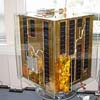
Clyde Space are offering the growing ranks of small satellite manufacturers power subsystem solutions for their missions. Based in purpose built facilities on West of Scotland Science Park in Glasgow, Clyde Space has a range of power subsystems for missions from as little as 1W up to in excess of 2.5kW. |
|
|

| The content herein, unless otherwise known to be public domain, are Copyright 1995-2006 - SpaceDaily.AFP and UPI Wire Stories are copyright Agence France-Presse and United Press International. ESA PortalReports are copyright European Space Agency. All NASA sourced material is public domain. Additionalcopyrights may apply in whole or part to other bona fide parties. Advertising does not imply endorsement,agreement or approval of any opinions, statements or information provided by SpaceDaily on any Web page published or hosted by SpaceDaily. Privacy Statement |