|
 |
 |
 |
 |
 |
 |
 |
 |

 |
Successful European DELTA Mission Concludes With Soyuz Landing
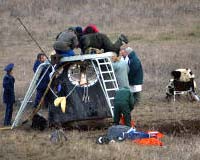
Paris (ESA) Apr 30, 2004 The 11-day DELTA mission to the International Space Station (ISS) came to a successful conclusion when the Soyuz TMA-3 command module, carrying Dutch ESA astronaut Andr� Kuipers and the ISS Expedition 8 crew, touched down early this morning near the town of Arkalyk in Kazakhstan at 07:12 local time (02:12 Central European Summer Time) after a return flight of just over three hours. The mission, which included nine days on the International Space Station, was faultlessly executed, with the achievement of all of major objectives. The intensive experiment programme was successfully carried out, the ISS Expedition 8 crew was relieved and the Soyuz TMA-3 spacecraft, stationed at the ISS for the past six months to act as the crew lifeboat, was replaced. After the hatch between Soyuz TMA-3 and the ISS was closed yesterday, about 6.5 hours before today's landing, the crew carried out the standard procedures and checks prior to undocking. Some 3 hours later, the spacecraft undocked from the ISS with Kuipers as Flight Engineer, sitting on the left of Russian Federal Space Agency cosmonaut Alexander Kaleri, the Soyuz Commander. Kaleri and the second Flight Engineer, Michael Foale (NASA), were the returning Expedition 8 crew who had been stationed on the ISS since 20 October. During those six months Michael Foale had been the ISS Commander. All stages of the re-entry went according to plan. Soyuz TMA-3 went through module separation, prior to re-entry, with the spacecraft's utility and instrument-assembly modules being uncoupled from the command module and burnt up in the Earth's atmosphere. Unlike those two modules, the command module containing the crew is equipped with a heat shield and took a different flight profile, entering the Earth's atmosphere about 25 minutes before landing. The main parachute of the command module opened 10 minutes later. During the DELTA mission, Andr� Kuipers carried out one of the most extensive experiment programmes undertaken by a European astronaut so far on the International Space Station, in the fields of human physiology, biology, microbiology, physical science, Earth observation, education and technology. Many of these experiments were developed by Dutch researchers and built by Dutch industry and research institutions. "I am very pleased with the execution of the experiment programme", said ESA's Delta Mission Scientist, Marc Heppener, also from the Netherlands. "Andr� has had a very busy schedule for the past 11 days. I am also extremely pleased that we have already obtained scientific results during the mission itself, as in the case of the ARGES experiment for a new generation of energy-saving lamps. "There were a couple of problems with experiments and facilities at the beginning of the mission. However they have not overshadowed the overall achievements of the programme and the mission. The results obtained from the experiments will undoubtedly have an impact across many areas both on Earth and in space." The experiments have yielded results which should help industry to develop, for example, more efficient lighting for sports stadiums and roads and more efficient cooling systems. Tens of thousands of schoolchildren in the Netherlands, Germany and other countries benefited from the mission, having carried out the same seed germination experiment as Andr� Kuipers while he was on the ISS. The educational benefits of the mission will continue in the future through the production of educational materials to be distributed to 10 000 schools across Europe. These materials are compiled using video footage of experiments shot on the ISS during the mission. The DELTA mission was sponsored by the Dutch Government through the Ministry of Education, Culture and Science and the Ministry of Economic Affairs. During the mission Andr� Kuipers had numerous contacts with the media in the Netherlands and other countries and had conversations with the Dutch ministers Maria van der Hoeven and Laurens Jan Brinkhorst and Prime Minister Jan Peter Balkenende. Andr� also had the opportunity to talk over amateur radio to schoolchildren who had won the "Zeg het ISS" competition and answer their questions. "The success of the DELTA mission once again shows how working together on space activities increases possibilities for the future," said Mr J�rg Feustel-B�echl, ESA Director of Human Spaceflight. "ESA's cooperation with the Russian Federal Space Agency continues to produce excellent results. This is the fifth Soyuz mission to the ISS with an ESA astronaut, and its success heralds more Soyuz missions in the future, with two further missions under discussion for next year. The next flight by an ESA astronaut to the ISS on a Russian Soyuz will probably take place in April 2005. In addition to the positive impact that the DELTA mission will have in the scientific community, we are pleased how industry has taken an enthusiastic role in the mission experiment programme and how younger generations will benefit from having had a direct involvement in the mission. We are very satisfied with the highly professional manner in which Andr� Kuipers took to his task on his first mission in space. This mission has increased ESA's level of experience not only in the European Astronaut Corps for future short and long-term missions, but also in our mission control personnel." In addition to the experiment programme, the DELTA mission served to change the crew on board the ISS. The ISS Expedition 8 crew of Alexander Kaleri and Michael Foale arrived on the ISS on 20 October last year with ESA astronaut Pedro Duque, who returned from the Cervantes mission after 8 days on the ISS. The ISS Expedition 8 crew have now been replaced by the ISS Expedition 9 crew, Gennady Padalka and Edward Fincke (NASA), who arrived with Andr� Kuipers at the ISS in the Soyuz TMA-4 spacecraft on 21 April and are scheduled to return next October. Community Email This Article Comment On This Article Related Links SpaceDaily Search SpaceDaily Subscribe To SpaceDaily Express Space Station News at Space-Travel.Com
 NASA Had No Choice But To Buy Soyuz Flights
 Washington DC (SPX) Jan 09, 2006
NASA's announcement last week that it will pay Roskosmos $43.6 million for a round-trip ride to the International Space Station this spring, and an equivalent figure for an as-yet-undetermined number of future flights to the station until 2012, represents the agency's acknowledgment that it had no alternative. |
|
|

| The content herein, unless otherwise known to be public domain, are Copyright 1995-2006 - SpaceDaily.AFP and UPI Wire Stories are copyright Agence France-Presse and United Press International. ESA PortalReports are copyright European Space Agency. All NASA sourced material is public domain. Additionalcopyrights may apply in whole or part to other bona fide parties. Advertising does not imply endorsement,agreement or approval of any opinions, statements or information provided by SpaceDaily on any Web page published or hosted by SpaceDaily. Privacy Statement |