|
 |
 |
 |
 |
 |
 |
 |
 |

 |
Subaru Telescope Improves Its Eyesight By A Factor Of Ten
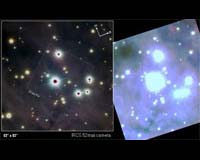
Tokyo, Japan (SPX) Nov 22, 2006 The Subaru telescope will be improving its eyesight by a factor of ten with the completion of a new adaptive optics and laser guide star system. For the past five years, Subaru's adaptive optics development team had been working on developing an advanced adaptive optics system to better remove the twinkle from starlight passing through Earth's atmosphere. At the same time, the team was developing a laser guide star system that can create an artificial star anywhere in the sky, opening up a larger portion of the sky to observations with adaptive optics. In October 2006, the team succeeded in testing both new systems on the telescope. On October 9, 2006, the team tested the new adaptive optics system and obtained an image of the Orion Nebula with ten times better resolution than without adaptive optics. A comparison of the new image with the first light image from when the Subaru telescope began observing in 1999 shows the dramatic increase in contrast and detail seen in the higher resolution image. Stars twinkle because light traveling from outer space is blurred by turbulence in Earth's atmosphere. Adaptive optics technology removes the twinkle from starlight, and allows astronomers to see greater detail in the objects they observe. Subaru's older adaptive optics system was a 36-element system. This means that it had 36 adjustable parts for smoothing out light to get a sharper image. The new system is a188-element system with five times more adjustable parts to make finer corrections. On October 12, 2006, the team projected a laser beam into the sky to produce an artificial star in the sodium layer of Earth's atmosphere, at an altitude of about 90 km. For an adaptive optics system to function, it needs a bright star, called a guide star, near the target object to measure the twinkle. If we rely only on real stars, only 1% of the celestial sphere is observable with adaptive optics. With the laser guide star system, developed by Subaru's adaptive optics team and researchers from Japan's Institute of Physical and Chemical Research (RIKEN), the entire sky observable from Mauna Kea will be accessible to Subaru's adaptive optics system. With the addition of these two new systems, the Subaru telescope will enable astronomers to study objects that were previously unobservable, such as the detailed structure of faint distant galaxies, imaging and spectroscopy of quasars and gamma ray bursters, and stellar population of nearby galaxies. This research was supported by a grant from MEXT, the Japanese Ministry of Education, Culture, Sports, Science and Technology. Community Email This Article Comment On This Article Related Links Subaru telescope All about the technology of space and more Stellar Chemistry, The Universe And All Within It Space Telescope News and Technology at Skynightly.com
 Russia Wants To Build Telescope Superior To Hubble
 Moscow (RIA Novosti) Nov 22, 2006
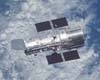
Russia will build a deep space exploration telescope that will outstrip the U.S.-made Hubble Space Telescope, a Russian astronomer said Tuesday. Hubble, orbited in 1990, has been the most successful and expensive project in astrophysics, costing over $6 billion. |
|
|

| The content herein, unless otherwise known to be public domain, are Copyright 1995-2006 - SpaceDaily.AFP and UPI Wire Stories are copyright Agence France-Presse and United Press International. ESA PortalReports are copyright European Space Agency. All NASA sourced material is public domain. Additionalcopyrights may apply in whole or part to other bona fide parties. Advertising does not imply endorsement,agreement or approval of any opinions, statements or information provided by SpaceDaily on any Web page published or hosted by SpaceDaily. Privacy Statement |