|
 |
 |
 |
 |
 |
 |
 |
 |

 |
Study Shows Eutrophic Lakes May Not Recover For A Millennium
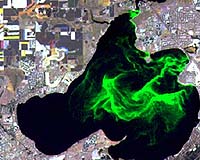
Madison WI (SPX) Jun 14, 2005 Although it has taken just 60 years for humans to put many freshwater lakes on the eutrophication fast track, a new study shows their recovery may take a thousand years under the best of circumstances. Writing in today's (June 13) online edition of the Proceedings of the National Academy of Sciences (PNAS), University of Wisconsin-Madison limnologist Stephen R. Carpenter reported results of a study that showed that the buildup of phosphorus in soils in lake watersheds is likely to be the source of serious chronic environmental problems for hundreds of years. "If these results are correct, and I suspect that they are, things could get considerably worse," says Carpenter, a UW-Madison professor of zoology and one of the world's leading authorities on freshwater lakes. "The buildup of phosphorus in watersheds is very threatening. Sooner or later it is going to hit the lakes and it is going to pose problems." Eutrophication occurs when nutrient-rich soil washes into lakes and streams. It stimulates the growth of algae and has transformed many of the world's lakes from clear freshwater reservoirs to soupy, weed-choked pools. It contributes to oxygen depletion, which leads to fish kills, and can stimulate the growth of toxic algae. According to the study, industrial agriculture, with its reliance on phosphorus-rich fertilizers, is the primary source of much of the excess nutrients responsible for fouling lakes. In rich farming areas, like southern Wisconsin, the routine application of chemical fertilizers and phosphorus-laden manure, has resulted in the gradual accumulation of phosphorus in the soil, which, ultimately, has nowhere to go but into the streams, lakes and rivers of the watershed where it is applied. "There's a huge amount of phosphorus in the watershed that hasn't washed into the lake yet," says Carpenter, meaning the problem is likely to persist for centuries. The new study models phosphorus loading into Lake Mendota, an urban lake in Madison, Wis., that still has nearly 80 percent of its watershed in the rich, dark soils of Wisconsin farm country. It ranks as one of the most studied lakes in the world, and in recent decades has experienced a steady decline in water quality due to accelerated runoff and the resulting eutrophication. But the lake is similar in most respects to lakes anywhere in the world, Carpenter says, and the results of the new study are generally applicable to lakes anywhere. "The global pattern is the same," he says. "We are releasing far more phosphorus to the soil than would be released by weathering." Restoring water quality is unlikely unless soil erosion is greatly reduced, phosphorus inputs are checked, and new technologies are developed for reducing phosphorus content of over-enriched soils, the report says. "This type of eutrophication is not reversible unless there are substantial changes in soil management," Carpenter writes in PNAS. The amount of phosphorus that runs into the lake in any given year is small, the Wisconsin scientist notes, but a little bit of the nutrient is all that is needed to send aquatic ecosystems into overdrive. Carpenter's model also shows that, unchecked, phosphorus pollution could put Lake Mendota on a fast track to extreme degradation. "There is a potential shift to an extremely degraded state that could occur even if we shut off the phosphorus tomorrow. It would have water quality as bad as the worst lakes in the world." Lakes that are that highly eutrophic, Carpenter notes, have a higher incidence of toxic algae blooms, which would make the lake unfit for swimming or exposure to domestic animals and pets. "And the odor cannot be underestimated. Lake Mendota has a certain smell about it on some summer days now," Carpenter explains, "but we're going to smell a lot more of that." Steps that can be taken immediately, Carpenter says, include eliminating the importation of chemical phosphorus to watersheds and limiting feed for cattle and other farm animals to feed that is grown in the watershed. At present, a significant amount of feed for farm animals is imported into the Lake Mendota watershed. Last year, the City of Madison implemented a ban on chemical phosphorus for lawn products, but farmers still apply phosphorus fertilizers, even when soils have a reservoir of the nutrient. The biggest help, Carpenter says, would come from reducing soil erosion rates. However, developing larger buffers around lakes and streams, restoring wetlands and encouraging the use of new manure storage and handling processes are also steps that can be taken to reduce phosphorus runoff. "Anything we can do to reduce the erosion of phosphorus is going to be beneficial," Carpenter says. Community Email This Article Comment On This Article Related Links University of Wisconsin-Madison SpaceDaily Search SpaceDaily Subscribe To SpaceDaily Express Water News - Science, Technology and Politics
 Hebrew University, Swiss Researchers Analyze Liquid That Lies Beneath The Surface
 Jerusalem, Jerusalem (SPX) Oct 12, 2005
While we generally think of water in nature as a cool liquid that we can see - streams, lakes, oceans - there is a great deal of "hot fluid" activity taking place far out of sight, deep within the earth, that influences what ultimately takes place on the surface, including the amount of rainfall and the buildup of new land mass. |
|
|

| The content herein, unless otherwise known to be public domain, are Copyright 1995-2006 - SpaceDaily.AFP and UPI Wire Stories are copyright Agence France-Presse and United Press International. ESA PortalReports are copyright European Space Agency. All NASA sourced material is public domain. Additionalcopyrights may apply in whole or part to other bona fide parties. Advertising does not imply endorsement,agreement or approval of any opinions, statements or information provided by SpaceDaily on any Web page published or hosted by SpaceDaily. Privacy Statement |