
 |
 |
 |
 |
 |
 |
 |
 |
 |

 |
Study Rules Out Inbreeding As Cause Of Amphibian Deformities
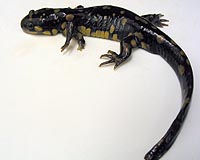
West Lafayette IN (SPX) Oct 30, 2008 Although research has linked inbreeding with elevated rates of deformity in a wide variety of animals, a new study finds it plays no part in the high incidence of malformation among salamanders. Purdue University researchers recently examined 2,000 adult and juvenile salamanders and found that 8 percent had visible deformities, mainly consisting of missing, extra or dwarfed digits (equivalent to fingers and toes). That is double the rate of malformation found in newts, a related amphibian, but on par and with frequencies seen in many frog species, said assistant professor of forestry and natural resources Rod Williams. "This is really the first study to test - and disprove - the hypothesis that inbreeding is responsible for malformations in salamanders," said Williams, corresponding author of the study published recently in the journal Biology Letters. Like many types of amphibians, tiger salamanders return to the same pond throughout their lives to mate. Williams and his former doctoral adviser, lead author Andrew DeWoody, hypothesized that habitat fragmentation or other factors might increase the probability that related salamanders could return to the same spot and mate. But their study found animals' genetic backgrounds to be unrelated to deformation rates; deformed salamanders were no more inbred than normal individuals. The population proved to be quite diverse, in fact, with roughly twice as much genetic variation as most land animals, DeWoody said. They calculated relatedness by measuring frequencies of alleles, which are copies or pairs of genes whose ratios are abnormally skewed in inbred individuals. High rates of amphibian malformation concern scientists not only because they threaten the survival of certain important species, but also because of what they signify about the health of the environment, said DeWoody, an associate professor. "Amphibians are a good bio-indicator species - real canaries in the coal mine," Williams said. Amphibians are more heavily impacted by water pollutants because of their semipermeable skin. Many species also begin life in water, where they risk contaminant exposure during their most vulnerable years, Williams said. The reason for high rates of deformation in salamanders, frogs and other amphibians remains a mystery, DeWoody said. With inbreeding ruled out, however, environmental factors like parasites, ultraviolet radiation and water pollution remain prime suspects, he said. Williams and DeWoody are actively looking for a cause or causes that may shed light upon high levels of malformation in frogs and other amphibians. "We've crossed out inbreeding as a possibility, an important step forward," DeWoody said. "But there's a lot of work yet to do." Community Email This Article Comment On This Article Share This Article With Planet Earth
Related Links Purdue University Darwin Today At TerraDaily.com
 World threatened by ecological 'credit crunch': WWF
 Paris (AFP) Oct 29, 2008
Reckless borrowing against Earth's exhausted bounty is driving the planet toward an ecological "credit crunch", the World Wildlife Fund warned on Wednesday. |
|
|

| The content herein, unless otherwise known to be public domain, are Copyright 1995-2007 - SpaceDaily.AFP and UPI Wire Stories are copyright Agence France-Presse and United Press International. ESA Portal Reports are copyright European Space Agency. All NASA sourced material is public domain. Additional copyrights may apply in whole or part to other bona fide parties. Advertising does not imply endorsement,agreement or approval of any opinions, statements or information provided by SpaceDaily on any Web page published or hosted by SpaceDaily. Privacy Statement |
 del.icio.us
 Digg
Digg Reddit
 YahooMyWeb
 Google
 Facebook