Energy News  
Study Finds Shuttle Exhaust Is Source Of Mysterious Clouds In Antarctica

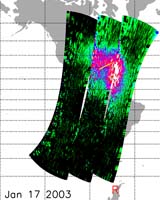
New satellite data from the Global Ultraviolet Imager (GUVI) on NASA's Thermosphere, Ionosphere, Mesosphere, Energetics and Dynamics (TIMED) satellite reveal the STS-107 main engine exhaust plume a day after the 16 January, 2003 launch (shuttle ground track overplotted in yellow). GUVI measures solar scattered Lyman ( radiation near 121.6 nm from atomic hydrogen, produced by photodissociated water vapor within the plume. A portion of the plume is shown moving south, where it is ultimately observed from the ground over Rothera (located at the "R"). After that, a burst of polar mesospheric clouds was observed over Antarctica, formed from the water vapor within the shuttle plume.

Washington DC (SPX) Jul 07, 2005
A new study, funded in part by the Naval Research Laboratory and the NASA reports that exhaust from the space shuttle can create high-altitude clouds over Antarctica mere days following launch, providing valuable insight to global transport processes in the lower thermosphere.

The same study also finds that the shuttle's main engine exhaust plume carries small quantities of iron that can be observed from the ground, half a world away.

The international team of authors of the study, which appears in the July 6 issue of Geophysical Research Letters, used the STS-107 Shuttle mission as a case study to show that exhaust released in the lower thermosphere, near 110 kilometers altitude, can form Antarctic polar mesospheric clouds (PMCs).

The thermosphere is the highest layer in our atmosphere, with the mesosphere (between 50-90 kilometers above the Earth), stratosphere, and troposphere below.

New observations presented by the research team from the Global Ultraviolet Imager (GUVI) on NASA's Thermosphere, Ionosphere, Mesosphere, Energetics and Dynamics (TIMED) satellite reveal transport of the STS-107 exhaust into the southern hemisphere just two days after the January 2003 launch.

Water from the exhaust ultimately led to a significant burst of PMCs during the 2002-2003 southern polar summer, observed by the Solar Backscatter Ultraviolet (SBUV) satellite experiment. The inter-hemispheric transport followed by Antarctic PMC formation were unexpected.

PMCs, also known as noctilucent clouds, appear near 83 kilometers altitude and are made up of water ice particles created through microphysical processes of nucleation, condensation, and sedimentation.

They typically appear in the frigid polar summer mesosphere where temperatures plummet below 130� Kelvin (-220� F). Little is known about the specific processes that lead to PMC formation.

According to the study's lead author, Dr. Michael Stevens, a research physicist at the E.O. Hulburt Center for Space Research at the Naval Research Laboratory, the research produced multiple groundbreaking science results.

"This research is exciting in that it extends a new explanation for the formation of these clouds by demonstrating the global effect of a Shuttle exhaust plume in a region of the atmosphere that has traditionally not been well understood," said Stevens.

Some believe that the impact of anthropogenic change in the lower atmosphere is reflected in these upper atmospheric clouds.

Although historically PMCs have only been seen in the polar region, in recent years PMCs have been spotted at lower latitudes as far south as Colorado and Utah, renewing interest and sparking debate on the implications.

However, the findings of this work, "call into question the interpretation of the impact of late 20th century PMC trends solely in terms of global climate change," Stevens said.

The team concludes that the water from a space shuttle's exhaust plume can contribute a remarkable 10-20 percent to PMCs observed during one summer season in Antarctica.


Community
Email This Article
Comment On This Article

Related Links
NRL
SpaceDaily
Search SpaceDaily
Subscribe To SpaceDaily Express
Nuclear Space Technology at Space-Travel.com


Memory Foam Mattress Review
Newsletters :: SpaceDaily :: SpaceWar :: TerraDaily :: Energy Daily
XML Feeds :: Space News :: Earth News :: War News :: Solar Energy News


Rewriting Glacial History In Pacific North America
Edmonton AB (SPX) Jan 10, 2006
Although the story on glacier fluctuations in northwestern North America over the last 10,000 years has remained largely unchanged for decades, new evidence discovered by a University of Alberta researcher will rewrite that glacial history and offer clues about our climate history during the last several thousand years.


  • Producing Ethanol And Biodiesel From Corn Not Worth The Energy: Study
  • Fuel Ethanol Cannot Alleviate US Dependence On Petroleum
  • Sun-Powered Aircraft To Support Sustainable Development
  • Nuclear Time-Bomb Ticks On Central Asian Valley's Edge

  • Japanese Nuclear Reactor Shuts Down, No Radioactive Leaks
  • British Nuclear Fuels Puts US Unit Westinghouse Up For Sale
  • Analysis: Brazil And Additional Protocol
  • Ukrainian Nuclear Energy Firm Halts Electricity Exports To Russia

  • Scientists Seek Sprite Light Source


  • EU Governments Keep National Bans On GMOs
  • Insects Resistant When Single And Double-Gene Altered Plants In Proximity
  • Insects Developing Resistance To Genetically Engineered Crops
  • East African Farming Genetically Transformed

  • Eco-Friendly Motor Rally Sets Off From Kyoto To Celebrate Environment

  • Boeing Facing Possible US Charges Over Aircraft Sales
  • EU Urges China To Liberalize Aviation Sector
  • NASA Announces Aerospace Systems Modeling Selection
  • BAE Systems Completes Acquisition of United Defense Industries

  • NASA plans to send new robot to Jupiter
  • Los Alamos Hopes To Lead New Era Of Nuclear Space Tranportion With Jovian Mission
  • Boeing Selects Leader for Nuclear Space Systems Program
  • Boeing-Led Team to Study Nuclear-Powered Space Systems

  • The content herein, unless otherwise known to be public domain, are Copyright 1995-2006 - SpaceDaily.AFP and UPI Wire Stories are copyright Agence France-Presse and United Press International. ESA PortalReports are copyright European Space Agency. All NASA sourced material is public domain. Additionalcopyrights may apply in whole or part to other bona fide parties. Advertising does not imply endorsement,agreement or approval of any opinions, statements or information provided by SpaceDaily on any Web page published or hosted by SpaceDaily. Privacy Statement