|
 |
 |
 |
 |
 |
 |
 |
 |

 |
Students To Drive Mars Rover
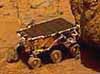
Washington - May 10, 1999 - Astronaut John Glenn and Bill Nye, the Science Guy, announced today an unprecedented opportunity for children around the world to join the first student team ever to serve on a planetary mission. This Planetary Society project will allow children hands-on participation in the operation of a Mars rover and robotic arm on the Mars Surveyor mission that launches in 2001. The announcement was made at the Space Day '99 celebrations at the National Air and Space Museum (NASM) in Washington, D.C. Red Rover Goes to Mars will be part of the NASA/JPL Mars Surveyor 2001 lander mission. This will be the first opportunity for active public participation in a space mission. "We stand on the threshold of an exciting millennium of exploration, one where the global public will become participants in the exploration of other worlds. Red Rover Goes to Mars will take students from around the world to a new frontier -- Mars," said Louis Friedman, Executive Director of the Planetary Society. "We hope it presages a future of more public involvement in planetary exploration." Among the featured speakers at the 10 am Space Day ceremony were Senator John Glenn; NASA Administrator Daniel Goldin; Bill Nye, a Planetary Society advisor; National Air and Space Museum Director Admiral Don Engen; and Vance Coffman, Chairman and CEO of Lockheed-Martin Corporation. Glenn and Coffman are the co-chairmen of the Embrace Space International Advisory Board. Red Rover Goes to Mars is an outgrowth of the Red Rover, Red Rover program -- a joint development of the Society, the Center for Intelligent Systems at Utah State University, Visionary Products, Inc., and the LEGO company. Using computers linked through the Internet, students teleoperate robotic rovers built from LEGO Dacta components. 400 Red Rover, Red Rover sites are already established worldwide in classrooms and science centers. Red Rover Goes to Mars will extend the network to the Red Planet itself, where student astronauts will have the first-ever opportunity to participate with the mission scientists, interfacing with a rover and a robotic arm on the lander. The rover will be the Marie Curie, the same type of rover as Sojourner, which was deployed on Mars in 1997. Student scientists and student astronauts will share their work and experiences via the Internet, delivering real mission data to homes, classrooms and science centers around the world. "Internet technology, which has opened up communications here on Earth, will now provide worldwide access to the adventure of planetary exploration," said Friedman. "It is, in the words of Vinton Cerf -- one of the Internet's founders -- the beginning of an 'interplanetary Internet.'" Red Rover Goes to Mars will be an international program, involving students from all over the Earth. One of the student astronauts selected for the program may one day be among the first astronauts on Mars, operating equipment on the planet's surface while safely housed in a Mars base - exactly as they will be doing for Red Rover Goes to Mars. One experiment on the Mars Surveyor 2001 mission that the students will follow closely is a student-designed "NanoExperiment." This experiment will be selected through a competitively judged contest sponsored by the Planetary Society, which is currently underway. The Society will also fund the construction of the flight-ready experiment. Red Rover Goes to Mars will be funded by The Planetary Society and the LEGO Company. The LEGO Company has been a principal partner with The Planetary Society in the development of Red Rover, Red Rover. The LEGO MINDSTORMS products, either the Robotic Invention System or the ROBOLAB product line for schools, will be used as a training tool for aspiring student astronauts in the program. LEGO Senior Vice President, Torben Sorensen says, "The space program is a powerful symbol of the value of education and achievement. LEGO is proud to work on this novel experiment with the Planetary Society and with NASA to provide new opportunities for educational outreach. This mission is a natural continuation of many years cooperation between the Society, NASA and LEGO in the education sector." Liberty Yogurt of Montreal, Canada will sponsor a poster for Red Rover Goes to Mars and will include information about the project on its products. The Mars Surveyor 2001 lander is scheduled for launch on April 10, 2001. If launched on schedule, it will land on Mars on January 22, 2002. Red Rover Goes to Mars will begin this year with a worldwide essay competition to select the student scientists. Participants must be born between January 31, 1984 and January 31, 1991. Students, parents and teachers interested in Red Rover Goes to Mars can use the following contact details;
Jeffrey Oslick, Ph.D.
Mars Challenge Reports At SpaceDaily
Pathfinder
Email This Article Comment On This Article Related Links Space
 Satellite Launch To Boost DTH In India
 Calcutta, India (SPX) Dec 28, 2005
The successful launch Thursday of India's heaviest satellite from spaceport of Kourou in French Guyana may have boosted the country's space research efforts to yet another level, but it has also lifted the spirits of at least three Direct-To-Home televisions broadcasters, one of which has been waiting for years to launch its services in India. |
|
|

|
|
|
|
|
|
|
|
|
|
|
|
| The content herein, unless otherwise known to be public domain, are Copyright 1995-2006 - SpaceDaily.AFP and UPI Wire Stories are copyright Agence France-Presse and United Press International. ESA PortalReports are copyright European Space Agency. All NASA sourced material is public domain. Additionalcopyrights may apply in whole or part to other bona fide parties. Advertising does not imply endorsement,agreement or approval of any opinions, statements or information provided by SpaceDaily on any Web page published or hosted by SpaceDaily. Privacy Statement |