
 |
 |
 |
 |
 |
 |
 |
 |
 |

 |
Students Prepare For Dust Up In Space
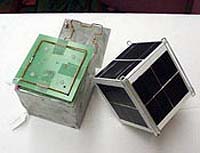
Leicester, UK (SPX) Jun 11, 2008 Undergraduates at the University of Leicester are on target to design, build and launch a student satellite on a real space mission. They have taken delivery of the main body of the satellite donated by Loughborough-based engineering company Magna Parva. The project will result in the satellite going into orbit in mid 2009. 20 students in the renowned Department of Physics and Astronomy are involved in the mission to detect space dust. Laura Evans, one of the programme leaders said: "Students from the department of Physics and Astronomy are involved in a project to design, build and launch a student satellite which will conform to the CubeSat standard developed by California Polytechnic. This is a major undertaking with Leicester undergraduates responsible for everything from inception to launch on a real space mission which will provide new, innovative science. "The University of Leicester's CubeSat project, named PLUME, started in January 2007 and aims to place an active nano-meteoroid dust detector into orbit by mid-2009. This detector will be capable of characterising the near Earth dust environment an order of magnitude better than any previously flown active detector, allowing significant science to be accomplished. "The project team is comprised of approximately 20 undergraduates who both run and manage the project. The mission has the full support of the University of Leicester's Space Research Centre and of Magna Parva. The team are also under consideration for financial support from the East Midlands Space Academy. "Provided the mission schedule is maintained the satellite is likely to be the first English CubeSat in orbit. "The nanometeoriod detector on PLUME will allow us to analyse dust particles that are smaller than ever before. Our satellite will be looking at the near-Earth environment so the results will be very relevant and of interest to theoreticians as well as experimentalists." Philip Peterson, 2nd year undergraduate working on the ADCS subsystem said:"I'm an undergraduate, and I'm building a satellite. It's just incredible. There aren't many universities in the country where I could get to do something like this." Professor George Fraser, Director of the University's Space Research Centre, said : "It's great to see Magna Parva's generous support helping turn our students' ambitious plans into real hardware" Andrew Bowyer, Director, Magna Parva Ltd said: ""We at Magna Parva are excited to be helping Leicester's undergraduates fly a very innovative instrument, and in doing so have been impressed by the professionalism of all concerned at the Space Research Centre. "Our intention is not just to contribute financially, but to be involved in the project up to launch. Through this integrated approach, the undergraduates will gain some experience of industry to add to their list of new skills." Community Email This Article Comment On This Article Share This Article With Planet Earth
Related Links Space Technology News - Applications and Research
 Northrop Grumman Resonating Gyro Achieves 10 Million Operating Hours In Space
 Woodland Hills CA (SPX) May 20, 2008
Northrop Grumman's patented hemispherical resonating gyro (HRG) technology recently surpassed 10 million hours of continuous service in support of myriad commercial and military space applications dating back to February of 1996. |
|
|

| The content herein, unless otherwise known to be public domain, are Copyright 1995-2007 - SpaceDaily.AFP and UPI Wire Stories are copyright Agence France-Presse and United Press International. ESA Portal Reports are copyright European Space Agency. All NASA sourced material is public domain. Additional copyrights may apply in whole or part to other bona fide parties. Advertising does not imply endorsement,agreement or approval of any opinions, statements or information provided by SpaceDaily on any Web page published or hosted by SpaceDaily. Privacy Statement |
 del.icio.us
 Digg
Digg Reddit
 YahooMyWeb
 Google
 Facebook