|
 |
 |
 |
 |
 |
 |
 |
 |

 |
Students Load 290 Samples For Biotechnology Experiment Headed To ISS
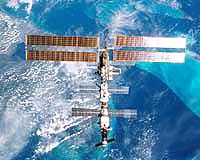
Huntsville - April 2, 2002 Hundreds of students and teachers from nine states have prepared 290 biological samples for an experiment astronauts will deliver to the International Space Station when Space Shuttle Atlantis returns to that unique, orbiting laboratory in April. Many of the students will be at Kennedy Space Center in Florida to watch as Atlantis lifts off with their experiments. "With this upcoming space mission, more students across America are learning how the Space Station can help us understand the biochemistry of plants and animals on Earth," said Ray French, project manager for the experiment at NASA's Marshall Space Flight Center in Huntsville, Ala. "By providing an opportunity to be part of a space experiment," said French, "the Space Station is touching the lives of a diverse group of students -- ranging from special needs students, to those who have never met a scientist, to chemistry students who hope to become NASA scientists." The students are participating in a Space Station biotech experiment led by Dr. Alex McPherson - a biochemist at the University of California, Irvine. Thanks to McPherson and his team, workshops to learn biochemistry and load samples are held in schools located in American settings ranging from the inner city, to suburbs, to small, rural towns. This is the first flight for students from four states - Indiana, Illinois, Ohio and West Virginia -- to participate in the experiment, sponsored by the NASA's Macromolecular Biotechnology Program at the Marshall Center. "My students have seen a new side of science as they work beside NASA and university scientists who are so dedicated to exploration and research," said Ronald Brady, a teacher at Lincoln West High School in Cleveland's inner city. "They've been exposed to a new type of laboratory experience, and it has made them think about their future careers." "In this NASA project I learned about proteins and how they help us in science," said Matthew Frankovic of Lincoln West High School. "Sending an experiment to space is a fun experience." Neil Rapp's chemistry students made the extra effort to work on the project after school at Bloomington High School South, one of two Indiana schools participating in the experiment. "They got a feel for what NASA does, and what they might choose as a career," Rapp said. "Our studies and discussions in the classroom of crystal structure were transformed from just being another section in the textbook to being a project they literally got their hands on." Students from the four states new to the program were joined by students from Alabama, California, Florida, Michigan and Texas - states that participated in preparing samples for the three prior flights of this experiment. "This opportunity opens students' eyes to so much of the world beyond," said LaVonda Popp, who teaches chemistry, physics and biology at Gatesville High School, a rural school in Gatesville, Texas. "Many of my students didn't know much about space, and this educational opportunity exposes them to careers and different areas of science conducted in space." A biological sample loaded by U.S. Sen. Conrad Burns of Montana also will be delivered to the Station. Montana students and teachers will be participating in future workshops, and will load samples to be flown on future Space Station missions. In these workshops -- held before each experiment flight to the Space Station -- students and teachers work beside scientists from the University of California, Irvine, other universities, and NASA. They prepare, freeze and seal biological solutions in small tubes. Just before launch, scientists place the samples in the Enhanced Gaseous Nitrogen Dewar - a thermos-like container -- that has an absorbent inner liner saturated with liquid nitrogen. After Space Shuttle Atlantis docks with the Space Station during the STS-110 mission in April, the crew will move the dewar to the Station. After about 10 days, when the nitrogen has evaporated and thawing is complete, the biological solutions will begin to form crystals. Students can view photos of some crystals grown during NASA workshops on a special Web site designed by Anna Holmes, a NASA scientist who conducts workshops at the University of Alabama in Huntsville. When the crystals grown in space are returned, McPherson and other biochemists will study them. Often, higher quality crystals can be grown in the low-gravity environment created as spacecraft circle Earth. Scientists use the crystals to map the structure of biological macromolecules - the building blocks that make up proteins, viruses and other substances that perform critical functions in our bodies and in animals and plants. "Preliminary results from the first crystals grown during the Enhanced Gaseous Nitrogen Dewar's first flight were encouraging," said Ron Porter, head of science planning for NASA's Macromolecular Biotechnology Program at the Marshall Center. "Over the course of three flights, more than 800 biological samples were delivered to the Station where crystals formed in microgravity over 40-day periods." The longer duration growth that is possible aboard the Space Station may enhance the quality of some crystals. Crystals grown on the Station in the fall of 2001 produced the highest quality thaumatin crystals ever grown on Earth or in space. Thaumatin is a protein from the African Serendipity berry or Thaumatocccus danielli and is valued for its intensely sweet taste. High quality crystals also were grown of pea lectin, glucose isomerase, concanavalin and lactalbumin, important industrial enzymes, as well as Bence-Jones protein, a protein used in anti-cancer therapeutic strategies. Knowledge of the precise three-dimensional molecular structure is an important tool for biochemists designing medicines. Scientists from academia and industry are using several other facilities on board the Space Station to grow biological crystals. The dewar is a relatively low-cost program that allows scientists to grow hundreds of crystals and to study optimum crystal growth conditions on the Station. On three previous Space Station missions, 445 teachers and students have participated in the experiment and sent samples to the Space Station. This education activity and the Enhanced Gaseous Nitrogen Dewar experiment are sponsored by the Macromolecular Biotechnology Program at the Marshall Center and the Office of Biological and Physical Research at NASA Headquarters in Washington, D.C. Community Email This Article Comment On This Article Related Links Student Access to Space Dewar Fact Sheet ISS Science Operations Office of Biological and Physical Research SpaceDaily Search SpaceDaily Subscribe To SpaceDaily Express Space Station News at Space-Travel.Com
 NASA Had No Choice But To Buy Soyuz Flights
 Washington DC (SPX) Jan 09, 2006
NASA's announcement last week that it will pay Roskosmos $43.6 million for a round-trip ride to the International Space Station this spring, and an equivalent figure for an as-yet-undetermined number of future flights to the station until 2012, represents the agency's acknowledgment that it had no alternative. |
|
|

| The content herein, unless otherwise known to be public domain, are Copyright 1995-2006 - SpaceDaily.AFP and UPI Wire Stories are copyright Agence France-Presse and United Press International. ESA PortalReports are copyright European Space Agency. All NASA sourced material is public domain. Additionalcopyrights may apply in whole or part to other bona fide parties. Advertising does not imply endorsement,agreement or approval of any opinions, statements or information provided by SpaceDaily on any Web page published or hosted by SpaceDaily. Privacy Statement |