|
 |
 |
 |
 |
 |
 |
 |
 |

 |
Students Get Insider's View Of Earth
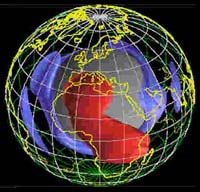
Ann Arbor - Dec 08, 2003 Blue, red and white waves dance inside a ball-shaped structure on a computer screen, colliding, careening and stretching in peculiar ways. This, explained University of Michigan geophysicist Peter van Keken, is what happens inside Earth when an earthquake occurs. But the dancing images represent something more to van Keken: a new approach to helping students -- as well as scientists and the public -- understand what's going on in the invisible realm beneath the planet's surface. Van Keken will discuss the approach Dec. 10 at a meeting of the American Geophysical Union in San Francisco. During the past century or so, scientists have become increasingly adept at using seismograms--measurements of the waves of energy that shake the ground during earthquakes -- to understand Earth's structure, said van Keken. But the emerging view of Earth's interior isn't a simple one. "We're starting to see this picture of a very complicated Earth, which is fine if you're a professional geologist but not if you're a student," he said. Introductory seismology courses typically use textbooks with illustrations that some students have trouble interpreting, said van Keken. "The question is, how do we go beyond this to better visualize what's going on inside the Earth?" Recently, van Keken has been exploring the use of computer animations to show seismic wave propagation in action and in three dimensions. His students currently use animations developed at the State University of New York at Binghamton and at Washington University in St. Louis, but together with scientists at the California Institute of Technology, van Keken is developing new, more complex visualizations and trying them out in the classroom. The various techniques complement one another, allowing students to start with simpler models and progress to more complicated, realistic representations, all the while learning how seismograms correspond to what's going on inside the Earth. Van Keken's visualizations run on Pcs, but can be enhanced using the GeoWall, a stereo projection system that combines new projection technology, fast graphics cards and Linux Pcs. After donning simple polarizing glasses, students can watch three-dimensional representations of structures and processes inside the Earth. The system, developed by researchers at the University of Michigan, the University of Minnesota and the University of Illinois at Chicago, also is used in other classes to help students understand landforms and their origins. In addition to using the visualizations in the classroom, van Keken employs them in his research to explore data and communicate findings to other scientists. Within the next year, he hopes to start using them to communicate with the public as well. "One of the ideas we have is that whenever a big earthquake happens, we'll run the computational codes, create the visualization and make it available to the media within 24 hours." Community Email This Article Comment On This Article Related Links GeoWall SpaceDaily Search SpaceDaily Subscribe To SpaceDaily Express Dirt, rocks and all the stuff we stand on firmly
 Magnetic Reconnection Region Larger Than 2.5 Million Km Found In The Solar Wind
 Paris (ESA) Jan 12, 2006
Using the ESA Cluster spacecraft and the NASA Wind and ACE satellites, a team of American and European scientists have discovered the largest jets of particles created between the Earth and the Sun by magnetic reconnection. This result makes the cover of this week's issue of Nature. |
|
|

| The content herein, unless otherwise known to be public domain, are Copyright 1995-2006 - SpaceDaily.AFP and UPI Wire Stories are copyright Agence France-Presse and United Press International. ESA PortalReports are copyright European Space Agency. All NASA sourced material is public domain. Additionalcopyrights may apply in whole or part to other bona fide parties. Advertising does not imply endorsement,agreement or approval of any opinions, statements or information provided by SpaceDaily on any Web page published or hosted by SpaceDaily. Privacy Statement |