|
 |
 |
 |
 |
 |
 |
 |
 |

 |
Student Rocket Test Successful
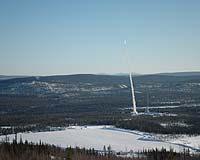
Esrange Space Center, Sweden (SPX) Apr 5, 2006 Swedish and German university students tested a Rexus 3 sounding rocket early Wednesday morning from the Swedish Space Corporation's launch site near Kiruna. The REXUS 3 - for Rocket-borne EXperiments for University Students - rocket took off at 07:56 in a technical test of systems to be used in the launch of a larger Maxus 7 rocket on May 2 that will expose its experiments package to microgravity for up to 14 minutes. The rocket is an unguided solid-propellant single-stage Orion M112 Hawk, which was obtained from military surplus. The motor is a dual-thrust burner with a boost phase of 5 seconds and a sustainer phase of approximately 21 seconds. The rocket accelerates the payload for 26 seconds, with peak acceleration during the boost phase of 21 Gs. It can carry payload mass of about 100 kilograms to an apogee of approximately 110 kilometers (68.2 miles). REXUS is meant to provide aerospace students with an experimental platform to gain experience in rocket design, project teamwork and management, all of which are important to their intended careers, said Olle Norberg, head of Esrange. The program is a joint project of the Swedish Space Corporation, Esrange, and the Mobile Rocket Base of the German Aerospace Center. Community Email This Article Comment On This Article Related Links REXUS Swedish Space Corporation Launch Pad at Space-Travel.com
 Delta II Pre-Launch Test Successful
 Vandenberg AFB CA (SPX) Apr 5, 2006
Engineers completed a flight simulation of the Delta II rocket Tuesday at Vandenberg's Space Launch Complex 2, while technicians prepared the rocket's payload - the CALIPSO and CloudSat spacecraft. The launch is scheduled for 6:02 a.m. Pacific Time on April 21. |
|
|

| The content herein, unless otherwise known to be public domain, are Copyright 1995-2006 - SpaceDaily.AFP and UPI Wire Stories are copyright Agence France-Presse and United Press International. ESA PortalReports are copyright European Space Agency. All NASA sourced material is public domain. Additionalcopyrights may apply in whole or part to other bona fide parties. Advertising does not imply endorsement,agreement or approval of any opinions, statements or information provided by SpaceDaily on any Web page published or hosted by SpaceDaily. Privacy Statement |