|
 |
 |
 |
 |
 |
 |
 |
 |

 |
Student Builds Micro Biosensor Chip To Move DNA Molecules
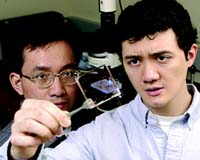
Baltimore - Mar 17, 2004 A Johns Hopkins undergraduate has constructed a new type of microchip that can move and isolate DNA and protein molecules. He believes that by linking the chip with analysis equipment, a user could identify medical ailments, monitor a patient's health or detect viruses and other biohazards before they spread. Eric Simone, a senior biomedical engineering major from the Cincinnati, Ohio, suburb of Anderson Township, fabricated and tested the chip in the lab of Jeff Tza-Huei Wang. Wang, an assistant professor in the Department of Mechanical Engineering, had already produced a biosensor chip with electrodes embedded in a straight line. Under Wang's supervision, Simone, 21, devised a biosensor chip with an innovative circular electrode design, which performed more effectively in certain bio-analytical applications. "This chip gives us a new tool to look into biological questions," said Wang, who also is a faculty member of the Whitaker Biomedical Engineering Institute at Johns Hopkins. "Eric can actually interact with and manipulate individual DNA molecules." Results from Simone's work were included a paper presented at the 17th IEEE International Conference on Micro Electro Mechanical Systems, held recently in The Netherlands. The undergraduate was listed as second author on the paper. Simone joined Wang's lab team in January 2003 and used a Provost's Undergraduate Research Award grant from the university to spend much of last summer working on his project. "The chip has tiny wires, each about one-fifth the diameter of a human hair, embedded in a circular pattern," Simone said. "When it's connected to a power source, it allows us to generate an electric field that can transport molecules to a designated area for study." The chips made by Wang and Simone take advantage of the natural negative charge possessed by DNA or a surface charge imposed on the molecules. A tiny drop of liquid containing the DNA is placed atop the chip. The electric field then guides the molecules to a designated area, where they can be analyzed under a microscope. Simone was one of the first students to work in Wang's new lab, which focuses on micro electro mechanical systems with biological applications. "It was fascinating," Simone said. "It was like discovering a whole new field of science." After graduating in May, Simone hopes to continue his education in a biomedical engineering doctoral program. Wang, who now has several other undergraduates working in his lab, was pleased to see how much these students can accomplish. "Once they are motivated," he said, "they do a really good job." On March 11, Steven Knapp, university provost and senior vice president for academic affairs, hosted the 11th annual Provost's Undergraduate Research Awards ceremony, which honored the 41 winners who conducted their projects in the summer and fall of 2003. Since 1993, about 40 students each year have received PURA grants of up to $3,000 to conduct original research, some results of which have been published in professional journals. The awards, funded through a donation from the Hodson Trust, are an important part of the university's commitment to research opportunities for undergraduates. The Johns Hopkins University is recognized as the country's first graduate research university, and has been in recent years the leader among the nation's research universities in winning federal research and development grants. The opportunity to be involved in important research is one of the distinguishing characteristics of an undergraduate education at Johns Hopkins. The Provost's Undergraduate Research Awards program provides one of these research opportunities, open to students in each of the university's four schools with full-time undergraduates: the Krieger School of Arts and Sciences, the Whiting School of Engineering, the Peabody Conservatory and the School of Nursing. Community Email This Article Comment On This Article Related Links Jeff Tza-Huei Wang's Lab Johns Hopkins Department of Mechanical Engineering SpaceDaily Search SpaceDaily Subscribe To SpaceDaily Express Space Medicine Technology and Systems
 Genomic Sequences Processed In Minutes, Rather Than Weeks
 Richland WA (SPX) Jun 22, 2005
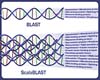
A new computational tool developed at the Department of Energy's Pacific Northwest National Laboratory is speeding up our understanding of the machinery of life - bringing us one step closer to curing diseases, finding safer ways to clean the environment and protecting the country against biological threats. |
|
|

| The content herein, unless otherwise known to be public domain, are Copyright 1995-2006 - SpaceDaily.AFP and UPI Wire Stories are copyright Agence France-Presse and United Press International. ESA PortalReports are copyright European Space Agency. All NASA sourced material is public domain. Additionalcopyrights may apply in whole or part to other bona fide parties. Advertising does not imply endorsement,agreement or approval of any opinions, statements or information provided by SpaceDaily on any Web page published or hosted by SpaceDaily. Privacy Statement |