|
 |
 |
 |
 |
 |
 |
 |
 |

 |
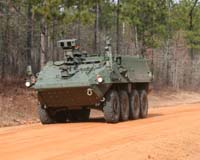
Stryker Ramps Up To Unveil Mobile Gun System
Fort Benning GA (AFNS) May 12, 2006 The newest version of the Stryker vehicle, designed to provide fire power to Infantry units, will be unveiled May 15 at Fort Knox's Armor Warfighting Symposium. The development of the Mobile Gun System is being managed by Fort Benning's Training and Doctrine Command System Manager-Stryker/Bradley. The system was developed to meet the infantry's need for a highly mobile support vehicle to supply rapid, direct fire, specifically during close assaults, said Dave Rogers, a TSM-Stryker senior analyst. The Mobile Gun System will eventually be integrated into Stryker Brigade Combat Teams. "The Mobile Gun System brings a tremendous battlefield capability to the Stryker formation, providing direct fire support to infantrymen in close, complex terrain," said Col. Donald Sando, the director of the TSM Stryker/Bradley. The Mobile Gun System's firepower includes a turret-mounted 105 mm cannon, a mounted M-240C machine gun and a pedestal-mounted M-2.50 caliber machine gun for the vehicle commander. The cannon can blast holes through reinforced concrete walls creating a breach point for infantry, and destroy bunkers and machine-gun nests that typically pin down infantry squads and platoons. The 105 mm cannon can also take out snipers, Rogers said, because with one shot, it can destroy the entire area where a sniper is firing from. The cannon also fires canister rounds, which are used when confronting large groups of combatants. The canister round sends out a spray of titanium balls, similar to the pellets from a shotgun, which can impact several targets at once. It's the heavy fire power and versatility that will make the Mobile Gun System an asset in combat, Rogers said. "People will assume it's a tank when they see it because it has a big gun," Rogers said, "but it's much lighter than a 70 ton tank, making it more mobile. Its primary role is to support the infantry, not to go head to head with tanks." The Mobile Gun System also features the Ammunition Handling System, an ammo loading device for the 105 mm cannon. With the ammo system, several types of rounds can be loaded in advance, then the ammunition types are displayed on the cannon operator's central control panel monitor. Depending on the mission, the operator can select which ammunition to use and the Ammunition Handling System automatically loads the cannon. This capability gives the Mobile Gun System an advantage over other Army vehicles, which must be manually loaded with specific ammunition by a fourth crew member, Rogers said. The Ammunition Handling System makes loading and firing on targets faster and more efficient, he said. "When planning for the 10 variants of Strykers, the Army took into account everything a Soldier could need on the battlefield," Rogers said. "From that, they developed the other Stryker variants, like the Medical Evacuation Vehicle, the Antitank Guided Missile Vehicle and the Engineer Squad vehicles, which are all uniquely designed for their mission. The Mobile Gun System fills a hole, and gives the infantry another capability." The Mobile Gun System will be the last Stryker variant to be fielded. The Nuclear, Biological and Chemical Reconnaissance Vehicle, the other new Stryker vehicle, was fielded to the 2nd Cavalry Regiment at Fort Lewis, Wash., in February. Soldiers with the 2nd Cav. Regt. will also be the first to receive the Mobile Gun System. They will receive 27 vehicles from July to August, which will be tested in an operational unit environment. The Army designated 14 Mobile Gun System vehicles for extensive testing at Aberdeen Proving Grounds, Md., Yuma Proving Grounds, Ariz., and White Sands Missile Range in New Mexico. Testing the vehicle in extreme climates and terrain helps the Mobile Gun System's designers look for potential problems that may appear in a combat environment. "People go to great pains to almost abuse the vehicle," Rogers said. "It's tested realistically in harsh settings so we can identify any shortcomings during the testing stage. We don't want to find out about a problem after it's in combat, so we're not cutting corners. During the tests, these vehicles aren't treated with kid gloves. We want to make sure we don't equip our Soldiers with a weak vehicle." It will still be a while before the Mobile Gun System will get to the battlefield. The Defense Acquisition Executive will decide if the vehicle should go into full rate production in July 2007. Annette Fournier writes for the Bayonet Community Email This Article Comment On This Article Related Links - The latest in Military Technology for the 21st century at SpaceWar.com
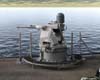
 BAE Systems Will Deliver Mk 38 Mod 2 Gun Mounts To US Navy
 Minneapolis MN (SPX) May 12, 2006
BAE Systems has received an additional order from the U.S. Navy to deliver 67, Mk 38 Mod 2 gun mounts to go aboard cruisers, destroyers and Landing Ship Transport Dock ships. The Mk 38 Mod 2 is a 25mm stabilized gun system that provides the last layer of ship protection. The system is highly autonomous and has an effective range of approximately 1 mile. |
|
|

| The content herein, unless otherwise known to be public domain, are Copyright 1995-2006 - SpaceDaily.AFP and UPI Wire Stories are copyright Agence France-Presse and United Press International. ESA PortalReports are copyright European Space Agency. All NASA sourced material is public domain. Additionalcopyrights may apply in whole or part to other bona fide parties. Advertising does not imply endorsement,agreement or approval of any opinions, statements or information provided by SpaceDaily on any Web page published or hosted by SpaceDaily. Privacy Statement |