|
 |
 |
 |
 |
 |
 |
 |
 |

 |
Strong Quake Could Trigger A Tsunami In Southern California
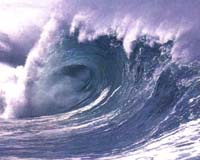
Los Angeles CA (SPX) Sep 24, 2004 With a strong enough jolt - a 7.6 -magnitude earthquake - the seafloor under Catalina Island could be violently thrust upward, causing a tsunami along the Southern California coast, according to researchers at the University of Southern California. In a pair of journal articles published this month, researchers at the Viterbi School of Engineering described the tsunami hazard associated with offshore faults, including one that lies under Santa Catalina Island, just 25 miles off the Los Angeles coast. "Catalina Island itself exists due to earthquake-related uplift on a geologic structure known as a restraining bend," said Mark Legg, a geophysicist working with the USC researchers, in the August issue of Earthquake Spectra. "Although most faults offshore Los Angeles and Orange counties are mostly strike-slip - faults that move side to side - bends in the fault line produce areas where the ground is pushed up during major earthquakes. One of these regions lies directly below Santa Catalina Island." Strike slip faults are not straight," added Jose C. Borrero, assistant research professor in the USC Viterbi School, who worked with co-researcher Costas E. Synloakis, USC professor of civil and environmental engineering, on the study. "Bends in the fault trace produce regions where earthquake stresses cause the sea floor to pop up and generate a tsunami". When a large earthquake occurs at a restraining bend, like the bend under Catalina Island, the ground is pushed up and, in turn, pushes up the entire region that has created the island and its offshore flanks. "Future earthquakes will push the region up further, possibly resulting in a tsunami," Legg warned. "Tsunami" is a Japanese word for waves caused by large motions of the sea floor, either through earthquakes, landslides or undersea volcanoes. They are generally associated with earthquakes that occur offshore and produce significant uplifting of the sea floor. Legg, who was awarded a fellowship through the National Earthquake Hazards Reduction Program to conduct research at the USC Viterbi School of Engineering, combined his earthquake modeling with computer simulation techniques developed at the university. "We took a range of potential earthquakes and investigated the tsunami potential from each case," Borrero explained. "We found there is significant amplification of tsunami energy into San Pedro Bay." The findings have important implications because San Pedro Bay�s south-facing shores are home to the largest container ports in the United States - the ports of Los Angeles and Long Beach. Billions of dollars of materials pass through these ports every day. A large earthquake and tsunami could bring commerce to a halt, seriously impacting not only California�s economy but the nation�s economy. "A magnitude 7.6 earthquake could cause seafloor uplift of six feet or more," Borrero said. "That, in turn, would disturb the sea surface by the same amount, resulting in a tsunami. The shallow San Pedro shelf offshore of Long Beach focuses the waves and amplifies them by one-and-a -half times, so the original six-foot wave would build to nine feet inside the harbor." The researchers said waves of that size could smash small boats at their moorings, possibly flood low-lying areas in the ports and push huge oil tankers and cargo ships against piers, which may not withstand the force. The destruction could create oil spills and become a serious fire hazard. In a related article published in the July 10 issue of Geophysical Research Letters, the researchers compared the worst-case scenario for tsunamis generated on three offshore faults and one submarine landslide. In addition to the largest of the Catalina fault scenarios, they looked at potential earthquakes on the Lasuen Knoll and San Mateo Thrust faults, which lie offshore of Orange and northern San Diego counties, as well as a large submarine landslide offshore of the Palos Verdes Peninsula. "The results are similar, but show that the ports of Los Angeles and Long Beach are particularly vulnerable to locally generated tsunamis," Borrero said. However, the analysis offered some good news: the same features that focus and amplify tsunami waves also slow the waves� arrival. "Our models show that depending on the source, there is anywhere from 15 to 20 minutes between the earthquake and the first significant waves in the ports," Borrero said. "This may give shippers enough time to evacuate dock workers and stop hazardous activities, such as cargo handling or offloading oil from tanker ships. Every second would count." Community Email This Article Comment On This Article Related Links USC Viterbi School of Engineering SpaceDaily Search SpaceDaily Subscribe To SpaceDaily Express Tectonic Science and News
 Ash Continuing To Spew From Vanuatu Volcano
 Sydney (AFP) Dec 12, 2005
Thousands of tonnes of ash are continuing to spew from a volcano in Vanuatu, but officials said Monday the activity on the South Pacific nation was not likely to result in a major deadly eruption. |
|
|

| The content herein, unless otherwise known to be public domain, are Copyright 1995-2006 - SpaceDaily.AFP and UPI Wire Stories are copyright Agence France-Presse and United Press International. ESA PortalReports are copyright European Space Agency. All NASA sourced material is public domain. Additionalcopyrights may apply in whole or part to other bona fide parties. Advertising does not imply endorsement,agreement or approval of any opinions, statements or information provided by SpaceDaily on any Web page published or hosted by SpaceDaily. Privacy Statement |