|
 |
 |
 |
 |
 |
 |
 |
 |

 |
Stellar Storm Points To First Exo-Planet Magnetic Field
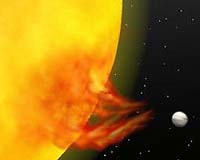
Vancouver - Jan 12, 2004 Canadian astronomers announced today the first evidence of a magnetic field on a planet outside of our solar system which is also the first observation of a planet heating its star. The report was presented last week by Ph.D. candidate Evgenya Shkolnik, Dr. Gordon Walker, both of the University of British Columbia, Vancouver, BC and Dr. David Bohlender of the National Research Council of Canada / Herzberg Institute for Astrophysics, Victoria, BC at the meeting of the American Astronomical Society in Atlanta, Georgia. The result may offer clues about the structure and formation of the giant planet. The trio observed the sun-like star HD179949 with the 3.6-meter (142-in) Canada-France-Hawaii Telescope atop Mauna Kea, Hawaii (a 14,000-ft. Dormant volcano) using its high-resolution spectrograph called Gecko. HD179949 is 90 light years away in the direction of the southern constellation of Sagittarius (the Archer) but it is too faint to be seen without a telescope. It was first reported to have a close-in planet by Tinney, Butler, Marcy and others in the first results of the Anglo-Australian planet search in 2000. The planet is at least 270 times more massive than the Earth, almost as big as Jupiter, and orbits the star every 3.093 days at 350,000 mph. Such tightly orbiting "roasters" or "hot jupiters" make up 20% of all known extrasolar planets. The star's chromosphere, a thin, hot layer just above the visible photosphere, was observed in the ultraviolet light emitted by singly-ionized Calcium atoms. Giant magnetic storms produce hot spots which are visible as bright patches in this light. Such a persistent hotspot is observed on HD 179949 keeping pace with the planet in its 3-day orbit for more than a year (or 100 orbits)! The hotspot appears to be moving across the surface of the star slightly ahead of, but keeping pace with the planet. Most evidence suggests the star is rotating too slowly to carry the spot around so quickly. The best explanation for this traveling hot spot is an interaction between the planet's magnetic field and the star's chromosphere, something predicted by Steve Saar of the Center for Astrophysics and Manfred Cuntz of the University of Texas at Arlington in 2000. If so, this is the first ever glimpse of a magnetic field on a planet outside of our solar system, and may provide clues about the planet's structure and formation. "If we are indeed witnessing the entanglement of the magnetic field of a star with that of its planet it gives us an entirely new insight into the nature of closely bound planets." -- Dr. Gordon Walker Obviously, more observations are needed to test if the magnetic interaction is a transient event or something longer lasting. Also, observations from the 8-meter Gemini-South Telescope in Chile of this stellar system are underway in the infrared light emitted by Helium which would map hotspots at higher levels of the chromosphere. Community Email This Article Comment On This Article Related Links Physics at University of British Columbia SpaceDaily Search SpaceDaily Subscribe To SpaceDaily Express Life Beyond Earth Lands Beyond Beyond - extra solar planets - news and science
 Latching Onto Lichen
 Moffett Field CA (SPX) Dec 06, 2005
Bacteria can often survive the harsh conditions of space, and their toughness and adaptability have made them key candidates for the transfer of life between planets. But in a recent study by European scientists, lichen survived a trip in space even better than bacteria do. |
|
|

| The content herein, unless otherwise known to be public domain, are Copyright 1995-2006 - SpaceDaily.AFP and UPI Wire Stories are copyright Agence France-Presse and United Press International. ESA PortalReports are copyright European Space Agency. All NASA sourced material is public domain. Additionalcopyrights may apply in whole or part to other bona fide parties. Advertising does not imply endorsement,agreement or approval of any opinions, statements or information provided by SpaceDaily on any Web page published or hosted by SpaceDaily. Privacy Statement |