|
 |
 |
 |
 |
 |
 |
 |
 |

 |
Stealthy New Deep-Sea Camera System May Find New Lifeforms
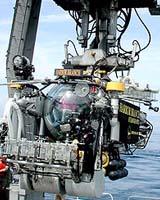
Fort Pierce - Jul 24, 2002 A Harbor Branch Oceanographic Institution scientist will soon combine stealth and ingenuity with a deep-sea self-contained underwater camera of her own design in a quest to capture images of creatures that live in the darkest depths of the world's oceans. You might say Dr. Edie Widder, a world-renowned expert in marine bioluminescence, is literally taking a scientific "shot in the dark" that may result in images of creatures that have never been seen before. The "Eye In The Sea" camera system Dr. Widder designed will be used for the first time on July 23 in the deep Monterey Canyon area off Monterey Bay, California, at depths of between 700 meters and 1,000 meters. What makes the camera so unique is its ability to sit alone on its tripod on the deep ocean bottom, waiting quietly for a flash of bioluminescence to bring it to life. The instant any creature in the inky depths flashes its chemical signal, the camera will record the bioluminescent flash, and then send out a beam of red light, invisible to the animal, while simultaneously taking a digital image. Dr. Widder explains why she hopes to capture images of creatures that may have remained undiscovered until now. For one thing, only a tiny percentage of the ocean depths have been explored and scientists believe there could be creatures living in those depths that humans have never seen. The second reason is simple; stealth. "A big noisy submersible with its bright lights can be seen or heard or otherwise sensed by deep-sea creatures from a long way away, and that has no doubt scared away a lot of animals," Dr. Widder said. Dr. Widder has been trying since 1994 to make her Eye In The Sea project a reality. She finally succeeded in launching the effort last year with a $35,000 check from Harbor Branch Oceanographic Institution (www.hboi.edu) to the Harvey Mudd College of Engineering for initial development. The National Oceanic and Atmospheric Administration (NOAA) provided $15,000 to help develop the deep-sea housing that has to protect the camera system from the crushing pressure at depth, and Dr. Widder has financed the rest of the project from her own Harbor Branch budget and from the sale of video and still images The Monterey Bay Aquarium Research Institute (MBARI) is providing Dr. Widder, an Adjunct Scientist at MBARI, ship and remotely operated vehicle (ROV) time and an extra set of the special batteries required by the system. From the research vessel Point Lobos, MBARI's ROV Ventana will transport the Eye In The Sea system to the depths of the Monterey Canyon. Dr. Widder plans to deploy Eye In The Sea for the first time on July 23rd, and the system will be retrieved and any images its taken will be downloaded the next day. It will then be dropped right back into the ocean depths for another 24 hours, and retrieved for the second time July 25th. Dr. Widder plans to deploy the camera for longer periods of time in other parts of the ocean after the system and any images it takes are evaluated. Community Email This Article Comment On This Article Related Links Harbor Branch Oceanographic Institution At Sea BioLuminescence SpaceDaily Search SpaceDaily Subscribe To SpaceDaily Express Dirt, rocks and all the stuff we stand on firmly
 Magnetic Reconnection Region Larger Than 2.5 Million Km Found In The Solar Wind
 Paris (ESA) Jan 12, 2006
Using the ESA Cluster spacecraft and the NASA Wind and ACE satellites, a team of American and European scientists have discovered the largest jets of particles created between the Earth and the Sun by magnetic reconnection. This result makes the cover of this week's issue of Nature. |
|
|

| The content herein, unless otherwise known to be public domain, are Copyright 1995-2006 - SpaceDaily.AFP and UPI Wire Stories are copyright Agence France-Presse and United Press International. ESA PortalReports are copyright European Space Agency. All NASA sourced material is public domain. Additionalcopyrights may apply in whole or part to other bona fide parties. Advertising does not imply endorsement,agreement or approval of any opinions, statements or information provided by SpaceDaily on any Web page published or hosted by SpaceDaily. Privacy Statement |