|
 |
 |
 |
 |
 |
 |
 |
 |

 |
Starsem Readies Launch Of Second European Navigation Satellite
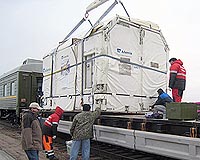
Baikonur, Kazakhstan (SPX) Mar 22. 2008 Preparations for Starsem's upcoming mission are in full swing at Baikonur Cosmodrome in Kazakhstan, with the European-built GIOVE-B navigation satellite payload now undergoing checkout, and the Soyuz launch vehicle advancing through the integration process. GIOVE-B was delivered to the launch site on March 13 along with its ground support equipment, arriving aboard an Antonov An-124 cargo jetliner. This specially-chartered aircraft touched down on the Baikonur Cosmodrome's Yubileiny runway, which previously served as the landing strip for Russia's space shuttle program. The GIOVE-B spacecraft and associated equipment were then transported approximately 15 km. To the clean room at Starsem's Payload Processing Facility, using the Cosmodrome's internal rail system for this transfer. After being unloaded from its protective shipping container, the satellite was powered up and linked to the ground support equipment for checkout. Also at the Cosmodrome, pneumatic testing with the Soyuz launcher's propulsion system has been performed, followed by the integration of the vehicle's four first stage boosters with its central core. Starsem's launch of GIOVE-B is planned for April 27 at 04:16:02 local time (00:16 Central European Summer Time, 22:16 UTC on April 26). This will be the 21st commercial mission for Arianespace's Starsem affiliate, and it follows last December's launch of the Canadian RADARSAT-2 commercial C-band synthetic aperture radar satellite. GIOVE-B is the second in-orbit validation spacecraft for Europe's new Galileo global navigation satellite system. It is designed to test novel, key technologies for the Galileo network, including the triple-channel transmission of navigation signals. The satellite carries a high-precision passive maser clock - the most accurate clock ever flown in space, and the spacecraft will be able to transmit MBOC (multiplexed binary offset carrier) signals in accordance with a recent compliance agreement for European/U.S. space-based navigation systems. GIOVE-B will have a liftoff mass of 530 kg., and was built by an industrial consortium headed by Astrium GmbH (Germany) as satellite prime, and Thales Alenia Space (Italy) as subcontractor for satellite assembly, integration and test. Starsem's April 27 launch is the company's second mission at the service of Europe's Galileo program, following the launch of GIOVE-A in December 2005. During GIOVE-A's more than two years in orbit, its signals have been received around the world, allowing for testing and calibration of the satellite's navigation data broadcasts. Community Email This Article Comment On This Article Related Links Giove-B Launch at ESA Starsem Arianespace GPS Applications, Technology and Suppliers
 Pioneering Galileo Satellite Begins Third Year In Orbit
 Guildford, UK (SPX) Jan 03, 2008
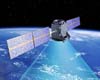
The first satellite in Europe's Galileo satellite navigation programme has achieved two years of highly successful in-orbit operation. GIOVE-A secured a crucial Galileo frequency filing with the International Telecommunications Union (ITU) and supported the development and validation of technology crucial to the future of Galileo. |
|
|

| The content herein, unless otherwise known to be public domain, are Copyright 1995-2007 - SpaceDaily.AFP and UPI Wire Stories are copyright Agence France-Presse and United Press International. ESA Portal Reports are copyright European Space Agency. All NASA sourced material is public domain. Additional copyrights may apply in whole or part to other bona fide parties. Advertising does not imply endorsement,agreement or approval of any opinions, statements or information provided by SpaceDaily on any Web page published or hosted by SpaceDaily. Privacy Statement |