|
 |
 |
 |
 |
 |
 |
 |
 |

 |
Star System Just Right For Building An Earth
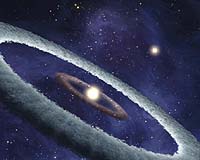
Pasadena CA (SPX) Oct 05, 2007 An Earth-like planet is likely forming 424 light-years away in a star system called HD 113766, say astronomers using NASA's Spitzer Space Telescope. Scientists have discovered a huge belt of warm dust - enough to build a Mars-size planet or larger - swirling around a distant star that is just slightly more massive than our sun. The dust belt, which they suspect is clumping together into planets, is located in the middle of the system's terrestrial habitable zone. This is the region around a star where liquid water could exist on any rocky planets that might form. Earth is located in the middle of our sun's terrestrial habitable zone. At approximately 10 million years old, the star is also at just the right age for forming rocky planets. "The timing for this system to be building an Earth is very good," said Carey Lisse, of the Johns Hopkins University Applied Physics Laboratory, Baltimore, Md. "If the system was too young, its planet-forming disk would be full of gas, and it would be making gas-giant planets like Jupiter instead. If the system was too old, then dust aggregation or clumping would have already occurred and all the system's rocky planets would have already formed."
The Right Stuff According to Lisse, the conditions for forming an Earth-like planet are more than just being in the right place at the right time and around the right star - it's also about the right mix of dusty materials. Using Spitzer's infrared spectrometer instrument, he determined that the material in HD 113866 is more processed than the snowball-like stuff that makes up infant solar systems and comets, which are considered cosmic "refrigerators" because they contain pristine ingredients from the early solar system. However, it is also not as processed as the stuff found in mature planets and asteroids. This means the dust belt must be in a transitional phase, when rocky planets are just beginning to form. How do scientists know the material is more processed than that of comets? From missions like NASA's Deep Impact - where an 820-pound impactor spacecraft collided with Comet Tempel 1 - scientists know that early star systems contain a lot of fragile organic material. That material includes water ice, carbonates and polycyclic aromatic hydrocarbons, which are carbon-based molecules found on charred barbeque grills and automobile exhaust on Earth. Lisse says that HD 113766 does not contain any water ice, carbonates, or fragile organic materials. From meteorite studies on Earth, scientists also have a good idea of what makes up asteroids - the more processed rocky leftovers of planet formation. These studies tell us that metals began separating from rocks in Earth's early days, when the planet's body was completely molten. During this time, almost all the heavy metals fell to Earth's center in a process called "differentiation." Lisse says that, unlike planets and asteroids, the metals in HD 113766 have not totally separated from the rocky material, suggesting that rocky planets have not yet formed. "The material mix in this belt is most reminiscent of the stuff found in lava flows on Earth. I thought of Mauna Kea material when I first saw the dust composition in this system - it contains raw rock and is abundant in iron sulfides, which are similar to fool's gold," said Lisse. Mauna Kea is a well-known volcano in Hawaii. "It is fantastic to think we are able to detect the process of terrestrial planet formation. Stay tuned - I expect lots more fireworks as the planet in HD113766 grows," he adds. Community Email This Article Comment On This Article Related Links Lands Beyond Beyond - extra solar planets - news and science Life Beyond Earth
 Colors Of Alien Plants
 Moffett Field CA (SPX) Oct 02, 2007
In May 2007, Victoria Meadows, Principal Investigator for the Virtual Planetary Laboratory at the California Institute of Technology's Spitzer Science Center, presented a lecture at NASA's Jet Propulsion Laboratory. In part five of this six-part edited series, she explores the impact plants have on planets, and how the type of star providing sunshine may affect the color of the alien equivalent of bushes, trees, and blades of grass. |
|
|

| The content herein, unless otherwise known to be public domain, are Copyright 1995-2007 - SpaceDaily.AFP and UPI Wire Stories are copyright Agence France-Presse and United Press International. ESA Portal Reports are copyright European Space Agency. All NASA sourced material is public domain. Additional copyrights may apply in whole or part to other bona fide parties. Advertising does not imply endorsement,agreement or approval of any opinions, statements or information provided by SpaceDaily on any Web page published or hosted by SpaceDaily. Privacy Statement |