
 |
 |
 |
 |
 |
 |
 |
 |
 |

 |
StarDust is on its way to Wild 2!
JPL - February 17, 1999 - 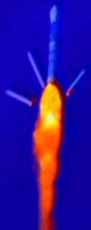 JPL - February 17, 1999 - After a one-day delay because of range safety issues with the Delta 2 C-band transponder, the StarDust launch team scored a virtual "bullseye" on the targeted outbound trajectory. JPL - February 17, 1999 - After a one-day delay because of range safety issues with the Delta 2 C-band transponder, the StarDust launch team scored a virtual "bullseye" on the targeted outbound trajectory.All injection parameters were well within the 3-sigma dispersion. The second stage "rocket camera" provided a spectacular view of the ride into space on a beautiful, cloudless Florida day. This triggered a big press response with great national coverage. The time of launch was 4:04:15.238 EST, against the instantaneous window. Spacecraft separation came at about 28 minutes after lift off. After separation from the Star-37 upper stage, StarDust did its own de-spin, deployed the solar arrays, got to its on-sun attitude, and performed a status check to be ready to telemeter data as soon as possible. Signal acquisition was near the earliest possible time, just after 5 P.M. EST and showed that the spacecraft was de-spun and on the sun. StarDust passed the moon the next day at 12:16 p.m. EST at a distance of 33,200 miles and speed of almost 12,000 mph. Hand-offs from Canberra to Madrid tracking was very smooth. The spacecraft is demonstrating excellent performance in all respects. Temperatures are tracking close to those from system thermal vacuum testing, but are generally a little warmer, which should provide some margin for aphelion when the spacecraft is at is farthest distance from the Sun. Initial trajectory tracking indicates that no trajectory correction maneuver (TCM) is required for February 22 as originally called for by the nominal flight plan. Tracking data will continue to accrue, and an assessment early next week will confirm whether a maneuver will be needed on Feb 22, or whether it should be simply delayed (which requires re-coordination of Deep Space Network (DSN) time) until better correlation of the actual accelerations with those predicted can be achieved. Current plans indicate we may turn on the Dust Flux Monitor (DFM) next week and the Cometary & Interstellar Dust Analyzer (CIDA) within two weeks. We are also looking at turning on the Navigation Camera and imaging the moon, if we do not need the Feb 22 TCM. It's great to have the "voyage" begun. I'm sure everyone is enjoying the pictures and new "movies" on the Web Site. It's great to be able to see where StarDust is at any time. After the launch, Don Brownlee and I made a "pilgrimage" back to the launch pad. It was impressive to see that place where so much of our last 3 1/2 years work had been just hours before...now empty. Launch Pad 17-A (SLC-17A) holds an important historic role in being the place where the first attempt to bring back cometary material launched off the planet . And other robotic explorers have also departed the planet from there: Mars Global Surveyor and Mars Climate Orbiter. It was a moving experience. And, now all the "passengers" on the chip are in deep space, beyond the moon and moving outbound. Let's have a wondrous journey of adventure and discovery.
StarDust at SpaceDaily
Email This Article Comment On This Article Related Links Space
 Satellite Launch To Boost DTH In India
 Calcutta, India (SPX) Dec 28, 2005
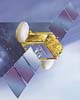
The successful launch Thursday of India's heaviest satellite from spaceport of Kourou in French Guyana may have boosted the country's space research efforts to yet another level, but it has also lifted the spirits of at least three Direct-To-Home televisions broadcasters, one of which has been waiting for years to launch its services in India. |
|
|

|
|
|
|
|
|
|
|
|
|
|
|
| The content herein, unless otherwise known to be public domain, are Copyright 1995-2006 - SpaceDaily.AFP and UPI Wire Stories are copyright Agence France-Presse and United Press International. ESA PortalReports are copyright European Space Agency. All NASA sourced material is public domain. Additionalcopyrights may apply in whole or part to other bona fide parties. Advertising does not imply endorsement,agreement or approval of any opinions, statements or information provided by SpaceDaily on any Web page published or hosted by SpaceDaily. Privacy Statement |

