|
 |
 |
 |
 |
 |
 |
 |
 |

 |
Stanford Innovation Helps 'Enlighten' Silicon Chips
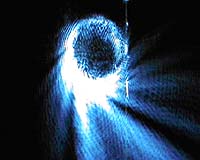
Stanford CA (SPX) Nov 24, 2005 Light can carry data at much higher rates than electricity, but it has always been too expensive and difficult to use light to transmit data among silicon chips in electronic devices. Now, electrical engineers at Stanford have solved a major part of the problem. They have invented a key component that can easily be built into chips to break up a laser beam into billions of bits of data (zeroes and ones) per second. This could help chips output data at a much higher rate than they can now. "Most of the high-performance optoelectronics-the stuff that connects optics and electronics-are made from moderately exotic materials, and putting them together with silicon has been hard," says David A. B. Miller, the W. M. Keck Foundation Professor of Electrical Engineering. "In the end you'd like to have one platform to make everything, and it would be good if that platform were based on silicon." That single platform is now much closer to reality. The discovery Miller and researchers including James Harris, the James and Ellenor Chesebrough Professor in the School of Engineering, announce in the Oct. 27 issue of the journal Nature is one that may enable a tiny modulator-a solid-state shutter-made of silicon and germanium. Because silicon and germanium are elements common in semiconductor manufacturing, the modulator could be built into chips easily and cheaply. Such a modulator could turn a beam into a stream of digital data by selectively absorbing the beam (a zero) or allowing it to continue on (a one). This would pave the way for at least some of the longer connections between chips to use light. Electrical connections have worked perfectly well up to now, but projected data rates have pushed engineers to find alternative approaches such as giving light a greater role. Miller and Harris estimate that the modulator, which could be about a millionth of a meter tall and about as long, could be made to operate at rates greater than 100 billion times a second, which is 50 times faster than the rate employed in computing hardware today and as fast as the highest rates being considered for optical communications.
Bucking conventional wisdom To make the modulator, Harris and Miller's research group had to buck the conventional wisdom that physics wouldn't allow it, says student researcher Yu-Hsuan Kuo. Understanding how electrons in atoms absorb-or don't absorb-incoming light is key to understanding why people thought a germanium-based modulator was impossible, and how Miller and Harris succeeded to a degree that surprised even them. Electrons can exist only in specific orbits around an atom's center. Each orbit is associated with an energy level. When light with the right amount of energy-or wavelength-hits an electron with the right amount of energy, the electron absorbs the light, using its energy to jump to the next allowed orbit. Applying a strong electric field to the atom can change the wavelength of light that the electron will absorb. This process has been known for more than a century as the Stark effect. The Stark effect allows materials to act as shutters for particular wavelengths of light, absorbing one or another as engineers turn an electric field on or off. With atoms themselves, the fields required to produce the Stark effect are so large that they would require a voltage too high to use in chips. But in very thin layers of some materials, a strong and sensitive version of this process, known as the quantum-confined Stark effect, occurs at acceptable voltages. Much of today's high-end telecommunications equipment uses thin materials featuring this effect to transmit data along fiberoptic cables.
Silicon surprise The trick was making this Stark effect work in materials compatible with chip manufacturing. Silicon and germanium both belong to a group of materials where the electrons do not appear favorably arranged for the Stark effect. What Miller, Harris and their group discovered is that this commonly accepted unfavorable appearance in germanium was deceiving. In fact, energy levels in germanium that are essentially immune to this Stark effect were obscuring more promising energy levels. The researchers set about to build and test a silicon-germanium device to see if they could indeed exploit this Stark effect in germanium. What they found is that when germanium layers are properly situated in a crystal with silicon, their electrons do not "leak" from useful levels into useless ones. The Stark effect could indeed work in germanium. What Harris and Miller didn't anticipate was how well it would work. "The surprising thing is that this effect actually works as well as in any current modulator-better than many," Harris says. In other words, using these modulators, which are compatible with computer chips, does not impair performance. Harris and Miller's research team included several students as well as consulting electrical engineering Professor Theodore I. Kamins. The students are Kuo, Yongkyu Lee, Yangsi Ge, Shen Ren and Jonathan E. Roth. The research was supported by Intel and the Defense Advanced Research Projects Agency. A key next step for the team is to show that they can make modulators for standard telecommunications wavelengths. They are confident that they can, and that their discovery can help usher in an "enlightened" age of computing and communications. David Orenstein is the communications and public relations manager at the Stanford School of Engineering. Community Email This Article Comment On This Article Related Links David A. B. Miller James Harris SpaceDaily Search SpaceDaily Subscribe To SpaceDaily Express Space Technology News - Applications and Research
 Industry Team Achieve New Communications Technology With AESA Radars
 Baltimore MD (SPX) Jan 12, 2006
A team comprised of three leading US aerospace and defense contractors has demonstrated an innovative technological use of active electronically scanned array (AESA) radars for high-bandwidth communications. |
|
|

| The content herein, unless otherwise known to be public domain, are Copyright 1995-2006 - SpaceDaily.AFP and UPI Wire Stories are copyright Agence France-Presse and United Press International. ESA PortalReports are copyright European Space Agency. All NASA sourced material is public domain. Additionalcopyrights may apply in whole or part to other bona fide parties. Advertising does not imply endorsement,agreement or approval of any opinions, statements or information provided by SpaceDaily on any Web page published or hosted by SpaceDaily. Privacy Statement |