|
 |
 |
 |
 |
 |
 |
 |
 |

 |
Squyres Getting A Handle On Home Plate
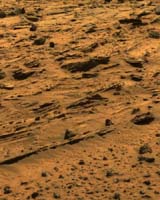
SpaceDaily US Editor Washington DC (SPX) Mar 20, 2006 As the Spirit rover leaves the formation named Home Plate on its way to its designated wintering area somewhere on or near the north-facing side of the peak named McCool - located in the Columbia Hills of Gusev Crater � the mission team at Jet Propulsion Laboratory is preparing for the annual reduction in solar energy and problems with the rover's right front wheel. Rover mission principal investigator Steve Squyres of Cornell University took time to answer a few questions from SpaceDaily.com about Spirit's status and the team's latest thinking about Home Plate: SpaceDaily: Is the front-wheel problem something you think can be overcome, or is this the rover's first irreparable mechanical breakdown? Steve Squyres: We're putting a press release together on the wheel situation, and I don't want to jump the gun. For now, we're driving with five wheels while we diagnose the right-front wheel problem. SD: Other reports are calling this a "drive or die" situation � that is, if the rover can't reach the north-facing highlands by winter, it won't have enough power to continue operating. Is that an accurate assessment? SS: I don't think it's correct to say that we have to reach a given position on McCool Hill in order to survive the winter. A better way of putting it is that when we get into the deepest part of winter, we'll need to have a north-facing tilt in order for the rover to keep doing science. On flat ground we may be able to keep the rover alive, but it won't be able to do much until the Sun starts to come back. With a northward tilt, we can still do things, as long as the tilt is great enough. So our hope is to get to a region where there is a broad expanse of northward-tilting terrain. This would give us both the power we need to do science, and plenty of terrain to do science on. Whether or not we'll be able to accomplish that remains to be seen, and, of course, other things could go wrong � mechanical failures, more dust buildup on the solar panels, and so forth. Right now, we're trying to move toward north-facing slopes, and we're taking it a day at a time. SD: What is your team's current thinking about Home Plate? When we last discussed this, about five weeks ago, you said it was too soon to speculate. Has your position changed? Do you have more information that supports a particular hypothesis? SS: All of Home Plate is made of altered basalt. There is nothing particularly exotic or unusual about its chemical composition or mineralogy. The layering, though, is very impressive. There's a lower unit that is coarse-grained and that we think was emplaced either by a volcanic explosion or an impact. There is some circumstantial evidence to favor the volcanic idea, but both possibilities are open. There's also an upper unit which is much more fine-grained, finely layered, and cross-bedded. Despite the difference in appearance, it has the same composition as the lower unit. It probably was emplaced in the same explosive event that created the lower unit. We also think it's plausible that after the upper unit was emplaced, it was reworked by the wind. Community Email This Article Comment On This Article Related Links Mars Rovers JPL NASA Mars News and Information at MarsDaily.com Lunar Dreams and more
 Mars Express Captures Hourglass Crater
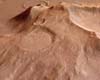 Paris France (SPX) Mar 19, 2006
ESA's Mars Express orbiter's High-Resolution Stereo Camera has compiled images and an accompanying video showing unusual flow deposits on the floors of two adjacent impact craters in the eastern Hellas Planitia region. The structures suggest possible glacial processes. |
|
|

| The content herein, unless otherwise known to be public domain, are Copyright 1995-2006 - SpaceDaily.AFP and UPI Wire Stories are copyright Agence France-Presse and United Press International. ESA PortalReports are copyright European Space Agency. All NASA sourced material is public domain. Additionalcopyrights may apply in whole or part to other bona fide parties. Advertising does not imply endorsement,agreement or approval of any opinions, statements or information provided by SpaceDaily on any Web page published or hosted by SpaceDaily. Privacy Statement |