|
 |
 |
 |
 |
 |
 |
 |
 |

 |
Square Kilometer Array Gets Study Fund Topup
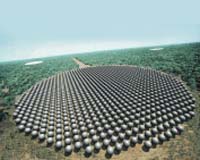
Ithaca - Nov 14, 2002 The National Science Foundation (NSF) has awarded $1.5 million over three years to help support early development of a massive new radio telescope by a Cornell University-led U.S. consortium of 10 universities and institutions. The proposed telescope would have 100 times the sensitivity of today's best radio telescopes, enabling it to "see" back to a primeval epoch by detecting galaxies in the early universe and hydrogen gas before it formed in the galaxies. The telescope, the Square Kilometer Array (SKA), would cost in the area of $1 billion and would be among the largest scientific instruments ever assembled. Eight national consortia from around the world are competing for the winning design and the site, which are not likely to be chosen until about 2007. Part of the NSF funding will be used to investigate feed antennas and low-temperature receivers, says James Cordes, professor of astronomy at Cornell, who is principal investigator on the research agency's award. The funding also will be used to investigate the problem of radio frequency (RF) interference that the SKA, with its wide bandwidth, will be subject to. "Part of the NSF funds will be used for taking data, acquiring data with existing facilities such as the Arecibo Observatory, and using prototypes for excising RF," says Cordes. The many problems that the development of the SKA will face depend on both its design and its siting. The U.S. consortium, chaired by Yervant Terzian, the David C. Duncan Professor in the Physical Sciences at Cornell, is discussing a telescope made up of about 100 stations, each made up of several hundred antennas, and spread out over a continentwide distance. In this way the antennas would form a telescope, called an interferometer, in which radio signals from distant objects in the universe are captured by separate antennas and brought together at a central processor. Indeed, the SKA would be by far the largest interferometer ever built. Although the array would cover an immense area, the actual collecting surfaces would cover a square kilometer, if placed end to end. "The U.S. concept is that if we can design a basic building block -- consisting of a single antenna -- we will need to stamp out many thousands of them," says Cordes. The challenge, he observes, is to design an antenna and the receiver system that will go with it, plus all of the necessary digital electronics, that would keep the cost of the SKA at $1 billion, an extremely low cost by current radio telescope standards. "We need to make the cost per square meter as small as possible," says Cordes. The NSF funding, he says, will be used to investigate such a design, with some of the work being carried out at Cornell by Cordes and by German Cortes-Medellin, a senior research associate with the National Astronomy and Ionosphere Center (NAIC) at Cornell, which manages the Arecibo Observatory in Puerto Rico for the NSF. Cordes will be collaborating with John Dickey, professor of astronomy at the University of Minnesota, and Steven Ellingson, a research scientist at Ohio State University, and with researchers at another NSF facility, the National Radio Astronomy Observatory in Socorro, N.M. All collaborating institutions are members of the U.S. SKA consortium. At a recent meeting of the consortium at Cornell, Terzian noted that the Southwest United States is a strong contender for the site of the SKA. The general siting criteria, he explained, include both construction and operating costs, as well as finding a site for "the best science." The data that will be acquired in coming months, he said, will include wind data, radio quietness, RF surveys, nature conservancy, labor costs and the costs of fiber optics. However, notes Cordes, there will be insufficient funds in the initial NSF grant to pay for the actual site testing. This would be covered by a second proposal that has been submitted to the NSF. Wearing his other hat as chairman of the international site selection committee, Terzian said there will be an international gathering of the consortia (from the United States, Canada, Europe, India, China and Australia) at the Arecibo Observatory, Puerto Rico, in January to discuss the process of making the selections for the location of the SKA. In the meantime, Cordes and his colleagues also are considering what would be a "realistic" scientific program for the SKA. "We want to see what the universe looked like before the galaxies were formed," he says. "One of our scientific goals is to nail down when the epoch of reionization took place. This will be part of the process of mapping out the whole timeline for hydrogen in the universe." Other members of the U.S. consortium, besides Cornell, Ohio State and the University of Minnesota, are the California Institute of Technology, Harvard-Smithsonian Center for Astrophysics, Massachusetts Institute of Technology, Naval Research Laboratory, SETI Institute, the University of California-Berkeley and the University of New Mexico. For more details see Community Email This Article Comment On This Article Related Links US Square Kilometer Array SpaceDaily Search SpaceDaily Subscribe To SpaceDaily Express Space Technology News - Applications and Research
 TeleRay Mobile Sat TV Antenna For Japan Auto Market
 Las Vegas CA (SPX) Jan 5, 2006
RaySat has introduced TeleRay, the world's smallest satellite TV vehicle antenna, into the domestic Japanese automotive market.
--------------------------------------------------------- It's new. And it's downright terrific! Celestron's CPC Schmidt-Cassegrain telescope is the scope you've been waiting for! It offers new alignment technology, advanced engineering, and bold new design at a new, low price! In fact, Celestron's Professional Computerized (CPC) scope with revolutionary SkyAlign Alignment Technology redefines everything that amateur astronomers are looking for. It offers quick and simple alignment, GPS technology, unsurpassed optical quality, ease of use, advanced ergonomics, enhanced computerization and, most important, affordability. Want to view M-31 tonight? One button takes you there!
Shop for telescopes online at Telescopes.com! today!
|
|
|

| The content herein, unless otherwise known to be public domain, are Copyright 1995-2006 - SpaceDaily.AFP and UPI Wire Stories are copyright Agence France-Presse and United Press International. ESA PortalReports are copyright European Space Agency. All NASA sourced material is public domain. Additionalcopyrights may apply in whole or part to other bona fide parties. Advertising does not imply endorsement,agreement or approval of any opinions, statements or information provided by SpaceDaily on any Web page published or hosted by SpaceDaily. Privacy Statement |