|
 |
 |
 |
 |
 |
 |
 |
 |

 |
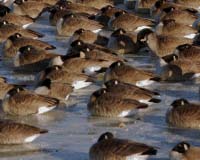
Spring Migration Of Pink Footed Geese Under Threat
Heteren, The Netherlands (SPX) Feb 14, 2006 As thousands of pink-footed geese (Anser brachyrhynchus) prepare for their spring migration north to breeding grounds in the Arctic, ecologists are warning that the escalating conflict between farmers and the geese is threatening the birds' survival. Writing in the new issue of the British Ecological Society's Journal of Applied Ecology, Professor Marcel Klaassen of the Netherlands Institute of Ecology says that international action is urgently required. Farmers in northern- and mid-Norway are threatening to scale up efforts to scare the birds off their fields, which the geese use as a staging post on their migration north, unless they are compensated for the damage to crops and grassland. Together with colleagues in Denmark and Norway, Klaassen used data from ringed geese collected between 1991 and 2003 to model the impact of organised scaring of pink-footed geese. They found that any rapid escalation of bird scaring could be catastrophic for the birds, especially for less experienced individuals. According to Klaassen: "The model predicts that if scaring on a large scale is implemented abruptly, it will have severe consequences for the population because the geese will not have time to adjust their behaviour to their dramatically changed environment. We are already seeing signs of decreasing annual breeding success and decreased summer survival as a result of poor body condition when the geese depart from the spring staging areas. Our model shows that na�ve geese have much lower fitness than experienced geese, which are able to anticipate and adapt to changes in their environment." There are two discrete populations of pink-footed goose: the Greenland/Iceland population, which breeds in Iceland and Greenland and overwinters in Britain; and the Svalbard population. The Svalbard group overwinters in Denmark, Belgium and the Netherlands and migrates to breeding grounds in Svalbard (an archipelago hundreds of miles off the north coast of Norway) in spring. On their migratory route north, the geese stop to feed on sheep pastures and emerging crops at Vester�len in northern Norway so that they arrive in Svalbard in good enough condition to breed successfully. Populations of the goose have almost doubled over the past twenty years, from between 23,000 and 30,000 in the 1980s to 45,000 today. This growth, coupled with loss of natural habitats, has forced geese to break their migration on farmland, and into conflict with farmers. "While conditions on the breeding grounds have generally remained unaffected by human activities, the staging and wintering grounds have undergone dramatic changes as a result of human development. As a result, most wintering populations have changed from feeding on natural or semi-natural habitats to agricultural land," Klaassen says. As well as helping to develop strategies to manage the conflict between farmers and geese, Klaassen's model could help ecologists predict how other species might respond to climate change. According to Klaassen: "We need tools to predict how organisms will respond to local and global changes, and such tools would be particularly useful if they could take into account adaptive behaviour. In the case of migratory birds, the implications of environmental change may be particularly difficult to predict because these animals use a succession of sites during their annual cycle." Community Email This Article Comment On This Article Related Links British Ecological Society Netherlands Institute of Ecology Darwin Today At TerraDaily.com
 Are There Aliens Already On Earth
 Seattle WA (SPX) Feb 20, 2006
Conspiracy theorists will readily tell you that the U.S. military is hiding alien corpses in a secret facility in the Nevada desert. But paleontologist and University of Washington geology professor Peter Ward thinks that scientists should be looking for a different type of alien life on earth: alien microbes. |
|
|

| The content herein, unless otherwise known to be public domain, are Copyright 1995-2006 - SpaceDaily.AFP and UPI Wire Stories are copyright Agence France-Presse and United Press International. ESA PortalReports are copyright European Space Agency. All NASA sourced material is public domain. Additionalcopyrights may apply in whole or part to other bona fide parties. Advertising does not imply endorsement,agreement or approval of any opinions, statements or information provided by SpaceDaily on any Web page published or hosted by SpaceDaily. Privacy Statement |