
 |
 |
 |
 |
 |
 |
 |
 |
 |

 |
Splashy Portrait Helps Explain How Stars Form
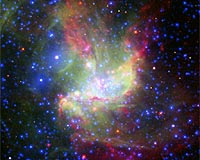
Heidelberg, Germany (SPX) Oct 09, 2008 Different wavelengths of light swirl together like watercolors in a new, ethereal portrait of a bright, star-forming region. The multi-wavelength picture combines infrared, visible and X-ray light from NASA's Spitzer Space Telescope, the European Southern Observatory's New Technology Telescope, and the European Space Agency's XMM-Newton orbiting X-Ray telescope, respectively. The colorful image offers a fresh look at the history of the star-studded region, called NGC 346, revealing new information about how stars form in the universe. NGC 346 is the brightest star-forming region in the Small Magellanic Cloud, a so-called irregular dwarf galaxy that orbits our Milky Way galaxy, 210,000 light-years away. "NGC 346 is an astronomical zoo," said Dimitrios Gouliermis of the Max Planck Institute for Astronomy in Germany, lead author of a new paper describing the observations in an upcoming issue of the Astrophysical Journal. "When we combined data at various wavelengths, we were able to tease apart what's going on in different parts of the cloud." Small stars are scattered throughout the NGC 346 region, while massive stars populate its center. The massive stars and most of the small stars formed at the same time out of one dense cloud, while other small stars were created later through a process called triggered star formation. Intense radiation from massive stars ate away at the surrounding dusty cloud, triggering gas to expand and create shock waves that compressed nearby cold dust and gas into new stars. The red-orange filaments surrounding the center of the image show where this process has occurred. But a set of even younger small stars in the region, seen as a pinkish blob at the top of the image, couldn't be explained by this mechanism. Scientists were scratching their heads over what caused this seemingly isolated group of stars to form. By combining multi-wavelength data of NGC 346, Gouliermis says he and his team were able to pinpoint the trigger as a very massive star that blasted apart in a supernova explosion about 50,000 years ago. According to the astronomers, this very massive star spurred the isolated young stars into existence before it died, but through a different type of triggered star formation than that which occurred near the center of the region. Fierce winds from the massive star, and not radiation, pushed dust and gas together, compressing it into new stars. The finding demonstrates that both wind- and radiation-induced triggered star formation are at play in the same cloud. According to Gouliermis, "The result shows us that star formation is a far more complicated process than we used to believe, comprising different competitive or collaborative mechanisms." The new image also reveals a bubble, seen as a blue halo to the left, caused by the supernova explosion that happened 50,000 years ago. Further analysis shows that this bubble is located within a large expanding gaseous shell, possibly powered by the explosion and the winds of other bright stars in its vicinity. Infrared light (red) shows cold dust; visible light (green) denotes glowing gas; and X-rays (blue) represent very warm gas. Ordinary stars appear as blue spots with white centers, while young stars enshrouded in dust appear as red spots with white centers. Other authors of this paper include Thomas Henning and Wolfgang Brandner of the Max Planck Institute for Astronomy, and You-Hua Chu and Robert Gruendl of the University of Illinois at Urbana-Champaign. NASA's Jet Propulsion Laboratory, Pasadena, Calif., manages the Spitzer Space Telescope mission for NASA's Science Mission Directorate, Washington. Science operations are conducted at the Spitzer Science Center at the California Institute of Technology, also in Pasadena. Caltech manages JPL for NASA. Community Email This Article Comment On This Article Share This Article With Planet Earth
Related Links Max Planck Institute for Astronomy Spitzer Space Telescope News and Technology at Skynightly.com
 The James Webb Space Telescope Model Is Flying To Germany
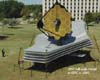 Greenbelt MD (SPX) Oct 09, 2008
The model of the James Webb Space Telescope has been making a lot of "orbits" around the world, and is now slated to "land" at the Deutsches Museum in Munich, Germany from October 13-28, 2008. |
|
|

| The content herein, unless otherwise known to be public domain, are Copyright 1995-2007 - SpaceDaily.AFP and UPI Wire Stories are copyright Agence France-Presse and United Press International. ESA Portal Reports are copyright European Space Agency. All NASA sourced material is public domain. Additional copyrights may apply in whole or part to other bona fide parties. Advertising does not imply endorsement,agreement or approval of any opinions, statements or information provided by SpaceDaily on any Web page published or hosted by SpaceDaily. Privacy Statement |
 del.icio.us
 Digg
Digg Reddit
 YahooMyWeb
 Google
 Facebook