|
 |
 |
 |
 |
 |
 |
 |
 |

 |
Spitzer's IRAC Camera Snaps Spectacular First Images
Washington - Dec 18, 2003 NASA released Thursday the first spectacular images from the Infrared Array Camera (IRAC) instrument on board the Spitzer Space Telescope. The pictures, taken at infrared wavelengths of light, revealed remarkable details in objects ranging from nearby star formation regions to distant spiral galaxies. The images are but a taste of what will come from IRAC, which was developed for NASA by a team led by the Smithsonian Astrophysical Observatory (SAO), with Giovanni Fazio as the Principal Investigator. "We are absolutely thrilled by the performance of IRAC, which has met or exceeded all expectations," says Fazio. "Every time we take a picture, we see something spectacular!" The three IRAC objects featured in today's press conference at NASA Headquarters are emission nebula IC 1396, spiral galaxy Messier 81 (M81), and Herbig-Haro 46 (HH 46). "Together, these three images show how IRAC will serve as a 'time machine,' giving us new information about the past, present, and future of our cosmos. Combined with its ability to peer into the distant past of the universe by studying highly redshifted galaxies, IRAC truly is lifting the cosmic veil and revealing hidden wonders," says Fazio.
IC 1396 The region of IC 1396 imaged by IRAC is a globule of gas and dust about 12 light-years in size. In visible light, it appears as a dark silhouette against the background of glowing nebular gas. Yet IRAC revealed it to be shining brightly at infrared wavelengths. This globule is a remnant of a much larger molecular cloud complex in Cepheus that already has formed populous star clusters. This leftover blob of gas and dust is being sculpted by the intense radiation from nearby massive, hot, young stars. "Radiation and hot winds are carving away the nebula like rust sandblasted from an old car. Eventually, it will vanish completely. We're lucky to have caught it in the act, to get a chance to see these stunning ethereal wisps before they disappear," says Fazio.
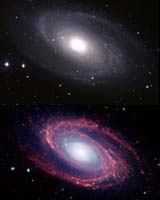
Messier 81 "By studying M81, we can get an outsider's view of our home. This is what aliens would see if they looked back at the Milky Way," says Fazio. In visible light, M81 displays an unremarkable disk and central bulge of stars. Dust lanes wind throughout the disk, hiding details of the galaxy's structure and composition. IRAC sweeps away that obscuration to clearly separate M81's stars (dominant in the near-infrared) from its hot dust (most visible at mid-infrared wavelengths). In doing so, IRAC uncovered areas where star formation is taking place, visible in the image as infrared-bright clumpy knots within the well-defined spiral arms. The huge amounts of dust revealed by IRAC, and the associated hydrogen gas, will provide raw materials for future star formation. The photo of M81 is a four-color composite of infrared light at wavelengths of 3.6 microns (blue), 4.5 microns (green), 5.8 microns (yellow), and 8.0 microns (red).
Herbig-Haro 46 The sharp infrared eyes of IRAC exposed the source of these jets - a young protostar embedded in an obscuring cloud of matter. "This youngster is still forming, and like any youngster, it's acting up a bit," says Fazio. Most young stars produce powerful jets during their birth, in a process yet to be fully understood by scientists. Those jets may help the star to collect infalling material by removing excess angular momentum. Without them, like an ice skater who pulls in his arms while spinning in place, the star soon would whirl so fast that centrifugal forces would stop its growth. While powerful jets are believed to assist forming stars, the jet of HH 46 is particularly strong, speeding outward across more than 9 light-years of space. (For comparison, the closest star to the Sun is only 4 light-years away.) The Infrared Array Camera is one of three science instruments on board the Spitzer Space Telescope. IRAC was developed by SAO and built at the NASA/Goddard Space Flight Center. The Spitzer Space Telescope mission is managed for NASA by the Jet Propulsion Laboratory, Pasadena, Calif., a division of the California Institute of Technology. The Spitzer Space Telescope, launched August 25 from Cape Canaveral, Fla., uses state-of-the-art infrared detectors to pierce the dusty darkness enshrouding such celestial objects as galaxies, stars, and planet-forming discs around stars. It is the fourth of NASA's Great Observatories, which include the Hubble Space Telescope, Chandra X-ray Observatory and Compton Gamma Ray Observatory. Community Email This Article Comment On This Article Related Links Spitzer Space Telescope at JPL Latest Images at Spitzer SpaceDaily Search SpaceDaily Subscribe To SpaceDaily Express Space Telescope News and Technology at Skynightly.com
 Cornell's Contract For Management Of Arecibo Observatory Renewed
 Ithaca NY (SPX) Apr 06, 2005
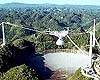
The National Science Foundation (NSF) has renewed Cornell University's management contract for the operation of Arecibo Observatory, the world's largest and most-sensitive single-dish radio/radar telescope.
--------------------------------------------------------- It's new. And it's downright terrific! Celestron's CPC Schmidt-Cassegrain telescope is the scope you've been waiting for! It offers new alignment technology, advanced engineering, and bold new design at a new, low price! In fact, Celestron's Professional Computerized (CPC) scope with revolutionary SkyAlign Alignment Technology redefines everything that amateur astronomers are looking for. It offers quick and simple alignment, GPS technology, unsurpassed optical quality, ease of use, advanced ergonomics, enhanced computerization and, most important, affordability. Want to view M-31 tonight? One button takes you there!
Shop for telescopes online at Telescopes.com! today!
|
|
|

| The content herein, unless otherwise known to be public domain, are Copyright 1995-2006 - SpaceDaily.AFP and UPI Wire Stories are copyright Agence France-Presse and United Press International. ESA PortalReports are copyright European Space Agency. All NASA sourced material is public domain. Additionalcopyrights may apply in whole or part to other bona fide parties. Advertising does not imply endorsement,agreement or approval of any opinions, statements or information provided by SpaceDaily on any Web page published or hosted by SpaceDaily. Privacy Statement |