|
 |
 |
 |
 |
 |
 |
 |
 |

 |
Spitzer Team Says Debris Disk Could Be Forming Infant Terrestrial Planets
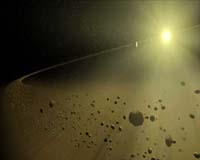
Tucson AZ (SPX) Dec 16, 2005 Astronomers have found a debris disk around a sun-like star that may be forming or has formed its terrestrial planets. The disk - a probable analog to our asteroid belt - may have begun a solar-system-scale demolition derby, where the rocky remains of failed planets collide chaotically. "This is one of a very rare class of objects that may give us a glimpse into what our solar system may have looked like during the formation of our terrestrial planets," said Dean C. Hines of the Space Science Institute, a leader of the team that discovered the rare objects with NASA's Spitzer Space Telescope. "The target is essentially a star similar to our sun, seen at a time when the terrestrial planets in our solar system were thought to have formed," Hines said. "We see evidence that this star might have an asteroid belt, roughly at the distance Jupiter is from our sun." "This object is very unusual in the context of all the others we've looked at," said University of Arizona assistant astronomy Professor Michael R. Meyer, a colleague in the discovery. Meyer directs a Spitzer Legacy project to study solar system formation and evolution in a sample of 328 young sun-like stars in the Milky Way. The project turned up the unusual system. "This is the only such debris disk among the 33 sun-like stars we've studied in our project so far, and one of only five such objects known," Meyer said. The star, named HD 12039, is about 30 million years old, or the age of the sun when the terrestrial planets are thought to have been 80 percent complete and the Earth-moon system formed, the astronomers said. It is roughly 137 light years away, or the distance light travels in 137 years. HD 12039 is a "G" type star like our sun, a yellow star with surface temperatures between 5,000 and 7,000 degrees Fahrenheit. It hasn't yet settled into the "main sequence," or mature nuclear-burning phase as our sun has. It's eight percent brighter, just slightly cooler and a little more massive than our sun, or 1.02 solar masses. The Spitzer team discovered that the star's debris disk temperature is 110 degrees Kelvin, or minus 262 degrees Fahrenheit. That's warmer than temperatures of the frigid outer debris disks that Meyer's Spitzer team commonly finds around sun-like stars. They've found that between 10 and 20 percent of the sun-like stars in their sample so far -- whether young, middle-aged or old -- have outer disks like our Kuiper Belt beyond Neptune. "The temperature of the dust in HD 12039's strange, narrow debris ring puts it between four and six astronomical units from the star -- smack dab where Jupiter is in our solar system," Meyer said. (An astronomical unit, or AU, is the mean distance between Earth and the sun, about 93 million miles.) "What's curious about this disk is that there's little if any dust inside four AU and beyond six AU. It's a narrowly confined ring that could be similar in some ways to the outer rings we see around Saturn," Meyer said. Just as small moons shepherd the ice grains orbiting Saturn into discrete rings, and just as Jupiter tends the outer edge of our solar system's asteroid belt, an unseen giant planet may be nudging dust into the narrow debris ring around this star, the astronomers said. "We think this is a tight, narrow ring of rocky objects similar to those in our asteroid belt, except this ring is five AU from its star, instead of two-to-three AU, the distance between our asteroid belt and the sun," Meyer said. "At 30 million years, the material we see in this star likely has to come from ground-up rocks in a zone where terrestrial planets could form," Hines said. NASA earlier this year announced a Spitzer telescope discovery of another of these alien asteroid belts. It orbits a two-billion-year-old sun-like star 35 light years away, at a distance comparable to that between Venus and the sun. Based on Spitzer Telescope results to date, only one percent to three percent of the young, sun-like stars in our Milky Way have massive terrestrial debris disks, Meyer said. "We could be witnessing a common, short-lived event through which all systems pass, or we could be seeing a rare example of a massive warm debris disk surrounding an unusual, sun-like star," Meyer said. The astronomers describe their work in an article to be published in The Astrophysical Journal. Community Email This Article Comment On This Article Related Links Spitzer at Caltech University of Arizona SpaceDaily Search SpaceDaily Subscribe To SpaceDaily Express Lands Beyond Beyond - extra solar planets - news and science Life Beyond Earth
 Study Highlights Role Of Hit-And-Run Collisions In Planet Formation
 Santa Cruz CA (SPX) Jan 12, 2006
Hit-and-run collisions between embryonic planets during a critical period in the early history of the Solar System may account for some previously unexplained properties of planets, asteroids, and meteorites, according to researchers at the University of California, Santa Cruz, who describe their findings in a paper to appear in the January 12 issue of the journal Nature. |
|
|

| The content herein, unless otherwise known to be public domain, are Copyright 1995-2006 - SpaceDaily.AFP and UPI Wire Stories are copyright Agence France-Presse and United Press International. ESA PortalReports are copyright European Space Agency. All NASA sourced material is public domain. Additionalcopyrights may apply in whole or part to other bona fide parties. Advertising does not imply endorsement,agreement or approval of any opinions, statements or information provided by SpaceDaily on any Web page published or hosted by SpaceDaily. Privacy Statement |