|
 |
 |
 |
 |
 |
 |
 |
 |

 |
Spitzer Sees New Planet Disk Around Dead Star
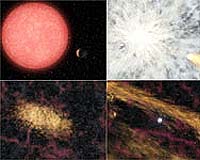
Pasadena CA (SPX) Apr 07, 2006 NASA's Spitzer Space Telescope has uncovered new evidence that new planets could emerge from the ashes of a supernova around dense, rapidly spinning stellar remnants called pulsars. "Now we can say that (planets around pulsars) are not uncommon," Aleksander Wolszczan of Penn State University told reporters at a news briefing about the discovery. "Planet formation is a much more robust phenomenon that we thought." Wolszczan and colleagues used the orbiting infrared telescope to survey the scene around a pulsar named 4U 0142+61. They found a surrounding disk made up of debris shot out during the star's death throes. The dusty rubble in the disk someday could glom together to form new planets. This is the first time scientists have detected planet-building materials around a star that died in a fiery blast. "We're amazed that the planet-formation process seems to be so universal," said team leader Deepto Chakrabarty of the Massachusetts Institute of Technology in Cambridge. "Pulsars emit a tremendous amount of high energy radiation, yet within this harsh environment we have a disk that looks a lot like those around young stars where planets are formed." Writing in the April 6 issue of Nature, the team said the finding could provide the missing piece in a puzzle that arose in 1992, when Wolszczan found three planets circling another pulsar, called PSR B1257+12. Those pulsar planets - two of which were the size of Earth - became the first planets of any type ever discovered outside of the solar system. Astronomers have since found indirect evidence those pulsar planets were born out of a dusty debris disk, but nobody had directly detected such a disk - until now. The pulsar observed by Spitzer is 13,000 light-years away in the Cassiopeia constellation. It was once a large, bright star with a mass between 10 and 20 times larger than the Sun. The star probably survived for about 10 million years, until it collapsed under its own weight about 100,000 years ago and blasted apart in a supernova. Some of the debris, or "fallback," from that explosion eventually settled into a disk orbiting the shrunken remains of the pulsar. Spitzer was able to spot the warm glow of the disk with its heat-seeking infrared instruments. The disk orbits at a distance of about 1 million miles and probably contains about 10 Earth-masses of material. Pulsars are a class of supernova remnants, called neutron stars, which are incredibly dense. They have masses about 1.4 times the Sun's squeezed into bodies only about 10 miles wide. One teaspoonful of a neutron star weighs about 2 billion tons. Pulsar 4U 0142+61 is an X-ray pulsar, meaning it emits X-ray radiation as it spins. Any planets around the stars that gave rise to pulsars would have been incinerated when the stars blew up. The pulsar disk discovered by Spitzer could represent the first step in the formation of a new and more exotic type of planetary system, similar to the one found by Wolszczan in 1992. "I find it very exciting to see direct evidence that the debris around a pulsar is capable of forming itself into a disk. This might be the beginning of a second generation of planets," he said. Pulsar planets would be bathed in intense radiation and would be quite different from those in our solar system. "These planets must be among the least hospitable places in the galaxy for the formation of life," said team member Charles Beichman, an astronomer at NASA's Jet Propulsion Laboratory and the California Institute of Technology. Community Email This Article Comment On This Article Related Links Spitzer JPL Stellar Chemistry, The Universe And All Within It
 Survey Reveals Building Block Process For Biggest Galaxies
 Leicester England (SPX) Apr 07, 2006
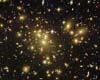
A new study of the universe's most massive galaxy clusters shows how mergers play a critical role in their evolution. Astronomers used the twin Gemini Observatory instruments in Hawaii and Chile, and the Hubble Space Telescope to study populations of stars in the universe's most massive galaxy clusters over a range of epochs - the earliest being nearly 7 billion years old, or half the age of the universe. |
|
|

| The content herein, unless otherwise known to be public domain, are Copyright 1995-2006 - SpaceDaily.AFP and UPI Wire Stories are copyright Agence France-Presse and United Press International. ESA PortalReports are copyright European Space Agency. All NASA sourced material is public domain. Additionalcopyrights may apply in whole or part to other bona fide parties. Advertising does not imply endorsement,agreement or approval of any opinions, statements or information provided by SpaceDaily on any Web page published or hosted by SpaceDaily. Privacy Statement |