|
 |
 |
 |
 |
 |
 |
 |
 |

 |
Spitzer And Hubble Create Colorful Masterpiece
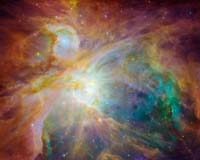
Washington DC (SPX) Nov 08, 2006 A new image from NASA's Spitzer and Hubble Space Telescopes looks more like an abstract painting than a cosmic snapshot. The masterpiece shows the Orion nebula in an explosion of infrared, ultraviolet and visible-light colors. It was "painted" by hundreds of baby stars on a canvas of gas and dust, with intense ultraviolet light and strong stellar winds as brushes. At the heart of the artwork is a set of four monstrously massive stars, collectively called the Trapezium. These behemoths are approximately 100,000 times brighter than our sun. Their community can be identified as the yellow smudge near the center of the composite. The swirls of green were revealed by Hubble's ultraviolet and visible-light detectors. They are hydrogen and sulfur gases heated by intense ultraviolet radiation from the Trapezium's stars. Wisps of red and orange detected by Spitzer indicate infrared light from illuminated clouds containing carbon-rich molecules called polycyclic aromatic hydrocarbons. On Earth, polycyclic aromatic hydrocarbons are found on burnt toast and in automobile exhaust. Additional stars in Orion are sprinkled throughout the image in a rainbow of colors. Spitzer exposed infant stars deeply embedded in a cocoon of dust and gas (orange-yellow dots). Hubble found less embedded stars (specks of green) and stars in the foreground (blue). Stellar winds from clusters of newborn stars scattered throughout the cloud etched all the well-defined ridges and cavities. Located nearly 1,500 light-years away from Earth, the Orion nebula is the brightest spot in the sword of the hunter constellation. The cosmic cloud is also our closest massive star-formation factory, and astronomers suspect that it contains about 1,000 young stars. The Orion constellation can be seen in the fall and winter night skies from northern latitudes. The constellation's nebula is invisible to the unaided eye, but can be resolved with binoculars or small telescopes. This image is a false-color composite, in which light detected at wavelengths of 0.43, 0.50, and 0.53 microns is blue. Light with wavelengths of 0.6, 0.65, and 0.91 microns is green. Light of 3.6 microns is orange, and 8-micron light is red. NASA's Jet Propulsion Laboratory, Pasadena, Calif., manages the Spitzer Space Telescope mission for NASA's Science Mission Directorate, Washington. Science operations are conducted at the Spitzer Science Center at the California Institute of Technology in Pasadena, which manages JPL for NASA. The Hubble Space Telescope is a project of international cooperation between NASA and the European Space Agency. The Space Telescope Science Institute in Baltimore conducts Hubble science operations. The Institute is operated for NASA by the Association of Universities for Research in Astronomy, Inc., Washington. Community Email This Article Comment On This Article Related Links Spitzer Hubble All about the technology of space and more Space Telescope News and Technology at Skynightly.com
 Russia, China To Launch Ultraviolet Observatory In 2010
 Shanghai, China (RIA Novosti) Nov 08, 2006
An ultraviolet observatory Russia, China and other countries are building to explore the far reaches of space will begin operating by the end of the decade, Russia's top space official said Tuesday. |
|
|

| The content herein, unless otherwise known to be public domain, are Copyright 1995-2006 - SpaceDaily.AFP and UPI Wire Stories are copyright Agence France-Presse and United Press International. ESA PortalReports are copyright European Space Agency. All NASA sourced material is public domain. Additionalcopyrights may apply in whole or part to other bona fide parties. Advertising does not imply endorsement,agreement or approval of any opinions, statements or information provided by SpaceDaily on any Web page published or hosted by SpaceDaily. Privacy Statement |