|
 |
 |
 |
 |
 |
 |
 |
 |

 |
Spirit Robot Rolls Out For Short Drive On Mars
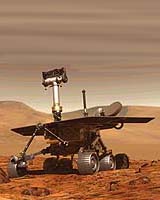
Washington (AFP) Jan 15, 2004 The US spirit robot successfully rolled off its landing platform onto Martian soil for a brief, three meter (10-foot) excursion early Thursday, the National Aeronautics and Space Administration said. The order to drive off was given around 0800 GMT, NASA officials said on their television channel. Once off the platform, the robot paused to realign its camera and transmission antenna before sending its data back to earth, the officials said. At 0954 GMT, data from Spirit began to come in. "We have carrier in line," said a NASA official, indicating the descent to Martian soil had been successful. At 1000 GMT, the first image of the landing vehicle beamed by Spirit already on the ground, was received at NASA's Jet Propulsion Laboratory in Pasadena, California. NASA scientists then prepared the Spirit for its historic drive on Mars. The immediate objective of Spirit's drive is to analyze soil samples to detect the presence of water, which could determine if life once existed on Mars and provide future space missions a much needed source of fuel and oxygen. Since its landing January 3, the Spirit has already beamed back to NASA's Jet Propulsion Laboratory in Pasadena, California, color images and other information about its landing terrain. NASA has been processing the images to make high-resolution color mosaics, the most detailed images ever taken of the red planet. The Spirit's long-awaited spin on Martian soil comes hours after US President George W. Bush on Wednesday announced new goal for the US space program -- sending manned missions to the Moon by as early as 2015, and to Mars and beyond later. The Spirit's exit from the landing platform was delayed three days after NASA encountered problems deflating one of the airbags that cushioned the landing of the probe's transport vehicle on Mars -- the journey from Earth took seven months. NASA was able to rotate Spirit 120 degrees to the right avoiding it from getting entangled in the remains of the airbag. Powered by solar energy, the robots Spirit and its twin Opportunity -- set to land on Mars late January 24 -- will be able to move 40 meters (125 feet) each Martian day, more than during the entirety of NASA's 1997 Pathfinder mission, with its 10-kilogram (22-pound) mini-robot Sojourner. Each robot will operate for three months on Mars. On Friday, Spirit's 13th day on Mars, the European probe Mars Express will pass over Gusev crater, said Ray Arvidson, one of the Mars Exploration Rover's project scientists. Mars Express may not be able to "see" Spirit, but the probe will take a series of measurements that will prove helpful to the US mission, via three German, French and Italian instruments "looking down," Arvidson said, praising the cooperative effort. "To our northeast, 250 meters (820 feet) to the northeast, is a crater 200 meters (655 feet) in diameter. This is an extremely attractive target," said mission scientist Steve Squyres, noting that it will "provide a window into the subsurface of Mars." "The goal of this site is to try to find materials that will tell us whether or not Gusev crater once contained a lake and what the conditions were like in that lake," Squyres said. Community Email This Article Comment On This Article Related Links SpaceDaily Search SpaceDaily Subscribe To SpaceDaily Express Mars News and Information at MarsDaily.com Lunar Dreams and more
 Spirit Heading To 'Home Plate'
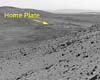 Pasadena CA (JPL) Jan 09, 2006
Last week Spirit completed robotic-arm work on "El Dorado." The rover used all three of its spectrometers plus the microscopic imager for readings over the New Year's weekend. |
|
|

| The content herein, unless otherwise known to be public domain, are Copyright 1995-2006 - SpaceDaily.AFP and UPI Wire Stories are copyright Agence France-Presse and United Press International. ESA PortalReports are copyright European Space Agency. All NASA sourced material is public domain. Additionalcopyrights may apply in whole or part to other bona fide parties. Advertising does not imply endorsement,agreement or approval of any opinions, statements or information provided by SpaceDaily on any Web page published or hosted by SpaceDaily. Privacy Statement |