|
 |
 |
 |
 |
 |
 |
 |
 |

 |
Spirit Clears Away Dust And Loads New Software
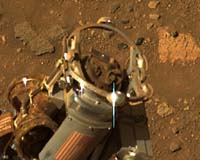
Pasadena CA (SPX) Jul 24, 2006 Beginning July 22 in the early hours of its 907th Martian day, or sol, Spirit began knitting together and testing all 200 pieces of new flight software that mission controllers transmitted to the rover in recent weeks. Meanwhile, Spirit remains healthy despite experiencing lower amounts of solar energy during the Martian winter. The Martian winter solstice will occur on Aug. 8. That day will mark the lowest amount of solar energy the rover is expected to receive: 275 watt-hours per sol (a hundred watt-hours is the amount of electricity needed to light one 100-watt bulb for one hour). The rover typically spends at least one sol recharging the batteries following each sol of heavy science activities. During sols 904 through 907, Spirit continued work on the 360-degree McMurdo panorama, examined a rock target called Halley Brunt with the microscopic imager, and took atmospheric measurements with the miniature thermal emission spectrometer. Spirit also completed a test of the rock abrasion tool. Rover handlers ran the grind motor on the rock abrasion tool backward three times to remove a clod of dust that was thought to be interfering with the operation of the device. After running the motor backward for three seconds at three different voltages - 5 volts, 8 volts and 10 volts - engineers concluded that the tool was operating normally and it either never had a problem or dislodged whatever was stuck beneath the bit. Sol-by-sol summary: Sol 904 (July 19): Spirit monitored atmospheric dust with the panoramic camera and acquired a mosaic of microscopic images of a rock and soil target known as Halley Brunt Offset1. The rover ran the rock abrasion tool backward to remove dust. In preparation for traversing and collecting data from a laminated patch of soil known as Palmer, the rover suspended the Moessbauer spectrometer above the target and documented the position of the instrument with the hazard avoidance cameras. Spirit continued to make progress on the McMurdo mosaic, acquiring one frame of column 24. Sol 905: The rover monitored atmospheric dust with the panoramic camera, acquired another frame of column 24 of the McMurdo panorama, checked for drift (changes with time) in the pointing of the miniature thermal emission spectrometer, and surveyed the sky and ground with the miniature thermal emission spectrometer. Sol 906: Commands for uplink on sol 906 called for Spirit to monitor atmospheric dust with the panoramic camera. The plan also included Spirit's task for the morning of sol 907, before that morning's uplink. This task is for Spirit to build the rover's new flight software package, a process that entails assembling, validating, and saving many thousands of lines of computer code sent from Earth in small packages during the past few weeks. Sol 907 (July 22): Plans called for Spirit to monitor atmospheric dust with the panoramic camera and check for drift (changes with time) in the pointing of the miniature thermal emission spectrometer. Spirit also was scheduled to conduct surveys of the sky and ground with the miniature thermal emission spectrometer and acquire the first frame of column 25 of the McMurdo pan. Odometry: As of sol 904 (July 19), Spirit's total odometry remained at 6,876.18 meters (4.27 miles). Community Email This Article Comment On This Article Related Links Mars Rovers at JPL Mars Rovers at Cornell Mars News and Information at MarsDaily.com Lunar Dreams and more
 Sunning Frozen Soil Could Answer Martian Life Question
 Pasadena CA (SPX) Jul 24, 2006
Pasadena CA (SPX) Jul 24, 2006 The answer to the question about life on Mars may very well come from analyzing an unsuspecting source - the soil, specifically the icy layer of soil underneath the red planet's surface. By analyzing the properties of Mars frozen layer of soil during NASA's next lander mission, scientists will be able to better understand and theorize about life on Mars. |
|
|

| The content herein, unless otherwise known to be public domain, are Copyright 1995-2006 - SpaceDaily.AFP and UPI Wire Stories are copyright Agence France-Presse and United Press International. ESA PortalReports are copyright European Space Agency. All NASA sourced material is public domain. Additionalcopyrights may apply in whole or part to other bona fide parties. Advertising does not imply endorsement,agreement or approval of any opinions, statements or information provided by SpaceDaily on any Web page published or hosted by SpaceDaily. Privacy Statement |