|
 |
 |
 |
 |
 |
 |
 |
 |

 |
Spirit Back At Work Sampling Columbian Rocks
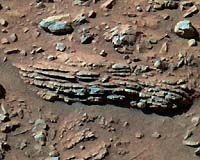
Pasadena CA (JPL) Oct 12, 2004 After working on Mars for three times as long as its primary three-month mission, Spirit is healthy and currently investigating the rock called "Tetl" in the "Columbia Hills." In the language of the ancient Mayans, tetl means stone. On sol 263, Spirit successfully drove approximately 7 meters (23 feet) and acquired images to build a digital elevation map of the hills. This put Spirit on the south side of a 2-meter-diameter (7-foot-diameter) depression, with Tetl on the opposite side. On sol 264, Spirit drove about 4 meters (13 feet) around the edge of the depression to keep the rover's solar panels (which are the rover's main power source) tilted toward the Sun. Since the Sun moves low across the northern sky over Gusev Crater at this time of year, rover planners are attempting to keep the solar panels tilted toward the north. The drive included use of the five-wheel mode to minimize use of the sticky right front wheel, which inefficiently pulls too much power when it is activated. Spirit also gathered additional about potential science targets, using the miniature thermal emission spectrometer and panoramic camera at the end of the rover's robotic arm. On sol 265, Spirit attempted to approach Tetl, but the drive ended early because the flight software detected that a steering brake control function did not work. Remote sensing data was still acquired. On sol 266, with an ongoing investigation of the steering anomaly, no further driving was planned. Several targets in front of the rover were selected for the alpha particle X-ray spectrometer and Moessbauer spectrometer. Spirit completed alpha particle X-ray spectrometer readings on two different locations. On sol 267, Spirit successfully acquired remote sensing data and moved its robotic arm to put the alpha particle X-ray spectrometer at a third position during the day and a fourth position overnight. On sol 268, Spirit acquired additional remote sensing data and performed a tool change to the Moessbauer spectrometer, then started an overnight integration with that instrument. On sol 269, Spirit continued the Moessbauer spectrometer integration and performed a diagnostic test on the steering brake. The test indicated that there was no problem with the commanding process at that time. On sol 270, Spirit acquired remote sensing data, stowed its arm, and ran another steering diagnostic test. The cause of the steering brake issue has not been identified, but tests indicate that electronics related to the brake function and the overall steering capabilities of Spirit are healthy. Engineers are proceeding with normal operations, including mobility. On sol 271, which ended on Oct. 7, Pacific Time, Spirit successfully drove approximately 2 meters (6.6 feet). This put Tetl within reach of the robotic arm. After the drive, Spirit used its navigation camera to view the scene from the rover's new location. Spirit has driven a total of 3,641 meters (about 2.3 miles) since landing nine months ago. Future plans for Spirit include more intense investigations of Tetl and a 20-meter (66-foot) drive to a target called "Machu Picchu." Community Email This Article Comment On This Article Related Links Mars Rovers at JPL Mars Rovers at Cornell SpaceDaily Search SpaceDaily Subscribe To SpaceDaily Express Mars News and Information at MarsDaily.com Lunar Dreams and more
 Spirit Heading To 'Home Plate'
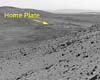 Pasadena CA (JPL) Jan 09, 2006
Last week Spirit completed robotic-arm work on "El Dorado." The rover used all three of its spectrometers plus the microscopic imager for readings over the New Year's weekend. |
|
|

| The content herein, unless otherwise known to be public domain, are Copyright 1995-2006 - SpaceDaily.AFP and UPI Wire Stories are copyright Agence France-Presse and United Press International. ESA PortalReports are copyright European Space Agency. All NASA sourced material is public domain. Additionalcopyrights may apply in whole or part to other bona fide parties. Advertising does not imply endorsement,agreement or approval of any opinions, statements or information provided by SpaceDaily on any Web page published or hosted by SpaceDaily. Privacy Statement |