|
 |
 |
 |
 |
 |
 |
 |
 |

 |
Spirit Arrives At Stratigraphic Wonderland In Columbia Hills On Mars
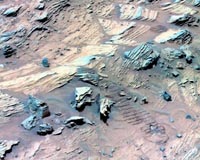
Pasadena CA (JPL) Sep 28, 2007 Spirit completed the rover's longest 5-wheel drive to date en route to a platy rock surface nicknamed "Texas Chili" in an area scientists are calling a "stratigraphic wonderland." The platy outcrop is at site 3 on top of "Home Plate" and is the focus of in-depth scientific investigation. Two sols after not receiving a scheduled data transmission, Spirit drove 19.21 meters (63.02 feet) to the rover's current location about 15 meters (49 feet) away from a field of boulders. Meanwhile, atmospheric dust levels continued to decline. Tau measurements of atmospheric opacity dropped to 1.06 on sol 1327 (Sept. 27, 2007), with a dust factor of 0.48. Spirit has been averaging 350 watt-hours per Martian day (100 watt-hours is the amount of electricity needed to light a 100-watt bulb for one hour). Scientific studies of the platy outcrop included alpha-particle X-ray spectrometer measurements both before and after brushing the surface, analysis with the Mossbauer spectrometer, and acquisition of microscopic images as well as a 360-degree panorama. Sol-by-sol summary Spirit began each Martian day by measuring atmospheric dust with the panoramic camera, checking for drift (changes with time) in the miniature thermal emission spectrometer, and surveying the sky and ground with the miniature thermal emission spectrometer. In addition to those tasks, Spirit completed the following activities: Sol 1321 (Sept. 21, 2007): Rather than completing the drive toward Home Plate as intended, Spirit executed the previous sol's activities. As a result of an internal failure in a station at the Deep Space Network in Madrid, rover handlers were unable to transmit instructions to Spirit via the rover's high-gain antenna. Sol 1322: Spirit spent the first sol of a three-sol weekend collecting remote science data, including panoramic camera images of a target known as "Ambrosia" and miniature thermal emission spectrometer measurements of Ambrosia as well as targets known as "Bisque" and "Cobbler." Sol 1323: Spirit acquired panoramic camera images of Bisque and Cobbler before completing the 19.21-meter (63.02-foot) drive to site 3 on Home Plate. The rover took images with the hazard avoidance cameras before and after ending the drive and acquired post-drive image mosaics with the navigation and panoramic cameras. Sol 1324: Spirit acquired near-field panoramic camera images and spent the third sol of a three-sol weekend collecting untargeted remote sensing data. Observations included movie frames in search of dust devils with the navigation camera and a systematic foreground survey with the miniature thermal emission spectrometer. Sol 1325: Spirit surveyed rock clasts with the panoramic camera and scanned the sky for clouds with the navigation camera. The rover began work on a 360-degree panorama as well as scientific studies of Texas Chili. Spirit acquired navigation camera images in support of observations with the miniature thermal emission spectrometer, completed a full-color, systematic, foreground survey using all 13 filters of the panoramic camera, and acquired a mosaic of images of site 3 with the panoramic camera. Spirit studied targets known as "Hardy Point," "Harmony Point," and "Ohridiski" with the miniature thermal emission spectrometer. The rover unstowed the robotic arm and placed the alpha-particle X-ray spectrometer on Texas Chili. Sol 1326: In the morning, Spirit monitored dust on the rover mast. Later, the rover acquired more panoramic camera images of site 3, brushed the surface of Texas Chili with the rock abrasion tool, and acquired images of the microscopic imager with the front hazard avoidance camera to monitor dust accumulation. Spirit placed the alpha-particle X-ray spectrometer back on the target and collected data for about 18 hours. Sol 1327: In the morning, Spirit received communications via the European Space Agency's Mars Express orbiter. The rover acquired more panoramic camera images of site 3, switched tools from the alpha-particle X-ray spectrometer to the Mossbauer spectrometer, and collected Mossbauer data from Texas Chili for about 21 hours. Sol 1328 (Sept. 28, 2007): Spirit took thumbnail images of the sky with the panoramic camera, re-started the Mossbauer spectrometer, and collected Mossbauer data from Texas Chili for about 25 hours. The rover took more panoramic camera images of site 3 and was slated to continue doing so the following morning. Odometry: As of sol 1327 (Sept. 27, 2007), Spirit's total odometry was 7,234.09 meters (4.49 miles). Community Email This Article Comment On This Article Related Links Mars News and Information at MarsDaily.com Lunar Dreams and more
 Are manned missions needed to explore Mars and beyond
 Paris (AFP) Sept 30, 2007
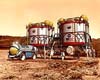
The United States has pledged to colonize the Moon by 2020 and send astronauts to Mars, but many scientists say dangerous and costly manned space missions should be a thing of the past, not the future. |
|
|

| The content herein, unless otherwise known to be public domain, are Copyright 1995-2007 - SpaceDaily.AFP and UPI Wire Stories are copyright Agence France-Presse and United Press International. ESA Portal Reports are copyright European Space Agency. All NASA sourced material is public domain. Additional copyrights may apply in whole or part to other bona fide parties. Advertising does not imply endorsement,agreement or approval of any opinions, statements or information provided by SpaceDaily on any Web page published or hosted by SpaceDaily. Privacy Statement |