
 |
 |
 |
 |
 |
 |
 |
 |
 |

 |
Spiky Probe On Phoenix Raises Vapor Quandary
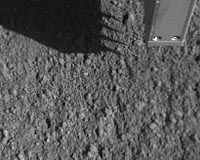
Tucson AZ (SPX) Sep 05, 2008 A fork-like conductivity probe has sensed humidity rising and falling beside NASA's Phoenix Mars Lander, but when stuck into the ground, its measurements so far indicate soil that is thoroughly and perplexingly dry. "If you have water vapor in the air, every surface exposed to that air will have water molecules adhere to it that are somewhat mobile, even at temperatures well below freezing," said Aaron Zent of NASA Ames Research Center, Moffett Field, Calif., lead scientist for Phoenix's thermal and electroconductivity probe. In below-freezing permafrost terrains on Earth, that thin layer of unfrozen water molecules on soil particles can grow thick enough to support microbial life. One goal for building the conductivity probe and sending it to Mars has been to see whether the permafrost terrain of the Martian arctic has detectable thin films of unfrozen water on soil particles. By gauging how electricity moves through the soil from one prong to another, the probe can detect films of water barely more than one molecule thick. "Phoenix has other tools to find clues about whether water ice at the site has melted in the past, such as identifying minerals in the soil and observing soil particles with microscopes. The conductivity probe is our main tool for checking for present-day soil moisture," said Phoenix Project Scientist Leslie Tamppari of NASA's Jet Propulsion Laboratory, Pasadena, Calif. Preliminary results from the latest insertion of the probe's four needles into the ground, on Wednesday and Thursday, match results from the three similar insertions in the three months since landing. "All the measurements we've made so far are consistent with extremely dry soil," Zent said. "There are no indications of thin films of moisture, and this is puzzling." Three other sets of observations by Phoenix, in addition to the terrestrial permafrost analogy, give reasons for expecting to find thin-film moisture in the soil. One is the conductivity probe's own measurements of relative humidity when the probe is held up in the air. "The relative humidity transitions from near zero to near 100 percent with every day-night cycle, which suggests there's a lot of moisture moving in and out of the soil," Zent said. Another is Phoenix's confirmation of a hard layer containing water-ice about 5 centimeters (2 inches) or so beneath the surface. Also, handling the site's soil with the scoop on Phoenix's robotic arm and observing the disturbed soil show that it has clumping cohesiveness when first scooped up and that this cohesiveness decreases after the scooped soil sits exposed to air for a day or two. One possible explanation for those observations could be thin-film moisture in the ground. The Phoenix team is laying plans for a variation on the experiment of inserting the conductivity probe into the soil. The four successful insertions so far have all been into an undisturbed soil surface. The planned variation is to scoop away some soil first, so the inserted needles will reach closer to the subsurface ice layer. "There should be some amount of unfrozen water attached to the surface of soil particles above the ice," Zent said. "It may be too little to detect, but we haven't inished looking yet." The thermal and electroconductivity probe, built by Decagon Devices Inc., Pullman, Wash., is mounted on Phoenix's robotic arm. The probe is part of the lander's Microscopy, Electrochemistry and Conductivity instrument suite. The Phoenix mission is led by Peter Smith at the University of Arizona with project management at NASA's Jet Propulsion Laboratory in Pasadena, Calif., and development partnership at Lockheed Martin in Denver. International contributions come from the Canadian Space Agency; the University of Neuchatel, Switzerland; the universities of Copenhagen and Aarhus in Denmark; the Max Planck Institute in Germany; and the Finnish Meteorological Institute.
Community Email This Article Comment On This Article Share This Article With Planet Earth
Related Links Phoenix at LPL Phoenix at JPL Phoenix at NASA Mars News and Information at MarsDaily.com Lunar Dreams and more
 Phoenix Analyzing Deepest Soil Sample Yet
 Tucson, AZ (JPL) Sep 03, 2008
Scientists have begun to analyze a sample of soil delivered to NASA's Phoenix Mars Lander's wet chemistry experiment from the deepest trench dug so far in the Martian arctic plains. Phoenix has also been observing movement of clouds overhead. |
|
|

| The content herein, unless otherwise known to be public domain, are Copyright 1995-2007 - SpaceDaily.AFP and UPI Wire Stories are copyright Agence France-Presse and United Press International. ESA Portal Reports are copyright European Space Agency. All NASA sourced material is public domain. Additional copyrights may apply in whole or part to other bona fide parties. Advertising does not imply endorsement,agreement or approval of any opinions, statements or information provided by SpaceDaily on any Web page published or hosted by SpaceDaily. Privacy Statement |
 del.icio.us
 Digg
Digg Reddit
 YahooMyWeb
 Google
 Facebook