
 |
 |
 |
 |
 |
 |
 |
 |
 |

 |
Spiders Make Best Ever Post-It Notes
Washington - Apr 26, 2004 Scientists have found that the way spiders stick to ceilings could be the key to making Post-it notes that don't fall off � even when they are wet. A team from Germany and Switzerland have made the first detailed examinations of a jumping spider's 'foot' and have discovered that a molecular force sticks the spider to almost anything. The force is so strong that these spiders could carry over 170 times their own body weight while standing on the ceiling. The research was published 19 April 2004 in the Institute of Physics journal Smart Materials and Structures. This is the first time anyone has measured exactly how spiders stick to surfaces, and how strong the adhesion force is. The team used a scanning electron microscope (SEM) to make images of the foot of a jumping spider, Evarcha arcuata (pictures available � see notes). There is a tuft of hairs on the bottom of the spider's leg, and each individual hair is covered in more hairs. These smaller hairs are called setules, and they are what makes the spider stick. The paper reveals that the force these spiders use to stick to surfaces is the van der Waals force, which acts between individual molecules that are within a nanometre of each other (a nanometre is about ten thousand times smaller than the width of a human hair). The team used a technique called Atomic Force Microscopy (AFM) to measure this force. The flexible contact tips of the setules are triangular (pictures available � see notes), and they have an amazingly high adhesive force on the underlying surface. Andrew Martin, from the Institute of Technical Zoology and Bionics in Germany, said, "We found out that when all 600,000 tips are in contact with an underlying surface the spider can produce an adhesive force of 170 times its own weight. That's like Spiderman clinging to the flat surface of a window on a building by his fingertips and toes only, whilst rescuing 170 adults who are hanging on to his back!" What makes the van der Waals force an interesting form of adhesion is that, unlike many glues, the surrounding environment does not affect it. The only thing that affects it is the distance between the two objects. "One possible application of our research would be to develop Post-it notes based on the van der Waals force, which would stick even if they got wet or greasy," said Professor Antonia Kesel, head of the research group in Bremen. "You could also imagine astronauts using spacesuits that help them stick to the walls of a spacecraft � just like a spider on the ceiling." The total van der Waals force on the spider's feet is very strong, but it is the sum of many very small forces on each molecule. The researchers believe the spider lifts its leg so that the setules are lifted successively, not all at once, and it does not need to be very strong to do this. All you would have to do to lift a future kind of Post-it note is peel it off slowly. The van der Waals force exists because the movement of electrons in atoms and molecules causes them to become dipolar. A dipolar atom or molecule has a "positive-pole" and a "negative-pole". The positive-pole of one atom or molecule will be attracted to the negative-pole of another. This particular electrostatic attraction is called the van der Waals force, and is in some ways similar to the magnetic attraction between north and south poles of magnets. "We carried out this research to find out how these spiders have evolved to stick to surfaces, and found that it was all down to a microscopic force between molecules. We now hope that this basic research will lead the way to new and innovative technology," said Professor Kesel. The paper, Getting a grip on spider attachment: an AFM approach to microstructure adhesion in arthropods, by Antonia Kesel, Andrew Martin and Tobias Seidl, will be published on 19 April 2004, in the Institute of Physics journal Smart Materials and Structures.
More Pixs:
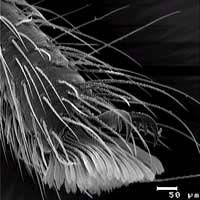
This SEM view of the underside of the scopula reveals the single hairs (setae) that make up the scopula. The oval represents the estimated scopula area (which is 0.032 m2). Magnification 270x.
This larger magnification of the underside shows that single setae are densely covered with numerous smaller hairs, called setules. The setule density averages 2.1 million setules per square millimetre. Magnification 3000x.
This view of the setae from above shows that there are fewer setules on the upper side of the setae. Magnification 3000x.
This SEM shows the setules on the underside of one seta. They are very dense and broaden toward the tip and end in a triangular sail-like area. Magnification 8750x.
The triangular tips of the setules stick to surfaces directly, by the van der Waals force. The average setule area (within each triangle) in this SEM micrograph is 0.00017 m2. Magnification 20000x. Email This Article Comment On This Article Related Links Institute of Physics SpaceDaily Search SpaceDaily Subscribe To SpaceDaily Express Space Technology News - Applications and Research
 NGC Chosen To Proceed With Developing Solid-State Laser Technology For Military Applications
 Redondo Beach CA (SPX) Jan 09, 2006
Northrop Grumman Corporation has been selected to develop "military-grade," solid-state laser technology that is expected to pave the way for the U.S. military to incorporate high-energy laser systems across all services, including ships, manned and unmanned aircraft, and ground vehicles. |
|
|

| The content herein, unless otherwise known to be public domain, are Copyright 1995-2006 - SpaceDaily.AFP and UPI Wire Stories are copyright Agence France-Presse and United Press International. ESA PortalReports are copyright European Space Agency. All NASA sourced material is public domain. Additionalcopyrights may apply in whole or part to other bona fide parties. Advertising does not imply endorsement,agreement or approval of any opinions, statements or information provided by SpaceDaily on any Web page published or hosted by SpaceDaily. Privacy Statement |



http://physics.iop.org/IOP/Press/spiders1d.jpg)

