|
 |
 |
 |
 |
 |
 |
 |
 |

 |
Spectrum Of Stormy Saturn
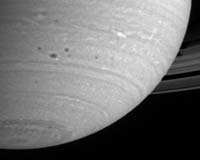
Moffett Field CA (SPX) Aug 23, 2004 Just as the world looks different through sunglasses, the Cassini spacecraft's cameras are able to pick up different features on Saturn and its many moons depending on which color filter is available. A recent image sequence highlights the contrast between short ultraviolet to long infrared wavelengths. The views showcase the strange nature of the ringed planet's southern pole, including new swirling patterns that seem to arise near the different latitudinal cloud bands. The banner image from the Cassini spacecraft's narrow angle camera includes Saturn's southern polar region and shows interesting details in the swirling boundaries between cloud bands (marked upper right). Two faint spots are visible at right, north and south of the boundary of the dark polar collar. The dark spot at the bottom of the image marks the planet's south pole. The image of cloud swirls was taken on July 19, 2004, at a distance of 6.2 million kilometers (3.9 million miles) from Saturn, through a filter which lets infrared light pass through. The image scale is 36 kilometers (22 miles) per pixel. Contrast was slightly enhanced to bring out features in the atmosphere. In contrast, Saturn's upper atmosphere, or stratosphere, is highlighted when using less penetrating wavelenghts than infrared. Instead, the (right) narrow angle ultraviolet image probes the high atmosphere above Saturn's south pole. A bright wedge near the lower-left limb falls in a latitude band which borders a darker latitude band a little closer to the pole. Viewing the limb of the planet in ultraviolet light allows researchers to sample the high part of the atmosphere (the stratosphere). It is worth noting that in ultraviolet the dark circle that marked the south pole in infrared now appears much less prominently. Ultraviolet is not able to penetrate so deeply into haze as infrared camera views. In addition to seeing cloud bands, scientists can discern from the ultraviolet image that the stratosphere in this latitude band is relatively pure hydrogen and helium and contains very little of the stratospheric haze which causes darkening closer to the pole. The image was taken by the Cassini spacecraft on July 26, 2004, at a distance of 7.1 million kilometers (4.4 million miles) from Saturn. The image scale is 42 kilometers (26 miles) per pixel. Contrast was slightly enhanced to bring out features in the atmosphere. Rotating bands of clouds is just part of the story being uncovered by studying the atmosphere. Saturn also plays host to strong storms, some of which are photographed using a visible red filter. The Cassini spacecraft wide angle camera view (upper right) shows a half-lit Saturn, with two dark storms rolling through its southern hemisphere. The image was taken in visible red light on July 19, 2004, at a distance of 6.2 million kilometers (3.9 million miles) from Saturn. The full image scale is 366 kilometers (227 miles) per pixel. Now that Saturn has revealed two new moons to satellite hunters, the job of probing this mini-solar-system deeper is one of Cassini's tasks. Saturn's crescent moon Dione hangs before the Cassini spacecraft in a magnified image (right) taken on July 19, 2004. The icy moon shows a hint of the bright, wispy features that mark its surface. Cassini's big adventure with Saturn's moon begins in earnest at the beginning of 2005, when the Huygens probe begins to descend to the surface of the largest moon Titan. European and American scientists hope to use Huygens to get a close-up view of what might provide analogies to what a very primordial Earth might have looked like, if it never progressed beyond an ice age. Just as Saturn seems like a miniature of our larger solar system, so too may its moons give a glimpse of what might have cooked up closer to the Sun than Saturn. Community Email This Article Comment On This Article Related Links Cassini at JPL Cassini Image Team SpaceDaily Search SpaceDaily Subscribe To SpaceDaily Express Explore The Ring World of Saturn and her moons Jupiter and its Moons The million outer planets of a star called Sol News Flash at Mercury
 Cassini Images Halo Around Titanic Moon Off Saturn
 Pasadena CA (SPX) Dec 27, 2005
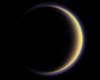
With its thick, distended atmosphere, Titan's orange globe shines softly, encircled by a thin halo of purple light-scattering haze. |
|
|

| The content herein, unless otherwise known to be public domain, are Copyright 1995-2006 - SpaceDaily.AFP and UPI Wire Stories are copyright Agence France-Presse and United Press International. ESA PortalReports are copyright European Space Agency. All NASA sourced material is public domain. Additionalcopyrights may apply in whole or part to other bona fide parties. Advertising does not imply endorsement,agreement or approval of any opinions, statements or information provided by SpaceDaily on any Web page published or hosted by SpaceDaily. Privacy Statement |