|
 |
 |
 |
 |
 |
 |
 |
 |

 |
Spacewalk: Pump Panel To ATV Prep
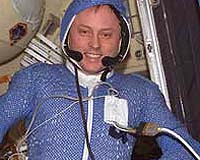
Houston (SPX) Sep 01, 2004 International Space Station Commander Gennady Padalka and NASA ISS Science Officer Mike Fincke will replace and install equipment during their fourth and final Expedition 9 spacewalk. Some of that equipment, three new antennas, will help guide the new Automated Transfer Vehicle (ATV) to its first docking to the Station late next year. Wearing Russian Orlan spacesuits - Paldalka's with red stripes, Fincke's with blue - the spacewalkers are scheduled to open the hatch of the Pirs Docking Compartment airlock at 12:50 p.m. EDT on Friday. NASA Television coverage will begin at 11:30 a.m. You can watch the coverage online. The first task is replacement of a pump panel atop the Zarya Control Module. It is part of the ISS Russian segment cooling system. This replacement is done as it approaches the end of its designed service life, and should take about an hour. Pump panel sensors monitor coolant levels and temperature and regulate the amount of coolant flowing through a radiator. The higher the temperature, the greater the coolant flow through the radiator. Next the spacewalkers will install fairleads, called "pigtails" because of their circular shape, on four Zarya handrails. Their function is to keep Russian spacesuit tethers from touching delicate experiments or equipment outside the Station during spacewalks. Installation should take about 15 minutes. A major task - it should take about two hours - is installation of the three antennas for the ATV. The European Space Agency's ATV is similar in some respects to the Russian Progress unpiloted cargo spacecraft, but it has a cargo capacity about 2.5 times that of the Progress. Its first flight is scheduled for the fall of 2005. For the ATV's automated docking system, Padalka and Fincke will install the antennas at the rear of the Zvezda Service Module. Attitude control thrusters will be disabled during this time for the crew's safety. The site is not far from the three laser reflectors and other antennas for the same system they installed during their Aug. 3 spacewalk. Three additional antennas will be installed during an Expedition 10 spacewalk. Expedition 10 crewmembers, Astronaut Leroy Chiao, commander, and Flight Engineer Salizhan Sharipov, are to be launched from the Baikonur Cosmodrome in Kazakhstan to the Station Oct. 9. Sharipov's fellow Cosmonaut Yuri Shargin will fly to the ISS with Expedition 10 and return to Earth with Expedition 9. If time permits, Padalka and Fincke will photograph the Japanese Micro-Particles Capture/Space Environment Exposure Device (MPAC/SEED) experiment. Being flown under a commercial agreement with the Russian Federal Space Agency, the experiment exposes various materials to the harsh environment of space. Finally, just before re-entering the Pirs, Padalka should take about 15 minutes to install handrail limiters near the airlock's hatch No. 2. These are covers that protect the handrails and act as a cushioning doorstop for the hatch. Moving from site to site occupies additional time. Hatch closure marking the end of the spacewalk is scheduled for 6:45 p.m. EDT. It could occur sooner if the spacewalkers continue working through periods of orbital darkness instead of resting. The spacewalk is the fourth for Fincke and the sixth for Padalka. Community Email This Article Comment On This Article Related Links SpaceDaily Search SpaceDaily Subscribe To SpaceDaily Express Space Station News at Space-Travel.Com
 NASA Had No Choice But To Buy Soyuz Flights
 Washington DC (SPX) Jan 09, 2006
NASA's announcement last week that it will pay Roskosmos $43.6 million for a round-trip ride to the International Space Station this spring, and an equivalent figure for an as-yet-undetermined number of future flights to the station until 2012, represents the agency's acknowledgment that it had no alternative. |
|
|

| The content herein, unless otherwise known to be public domain, are Copyright 1995-2006 - SpaceDaily.AFP and UPI Wire Stories are copyright Agence France-Presse and United Press International. ESA PortalReports are copyright European Space Agency. All NASA sourced material is public domain. Additionalcopyrights may apply in whole or part to other bona fide parties. Advertising does not imply endorsement,agreement or approval of any opinions, statements or information provided by SpaceDaily on any Web page published or hosted by SpaceDaily. Privacy Statement |