|
 |
 |
 |
 |
 |
 |
 |
 |

 |
Space Watch: Beckwith on Hubble
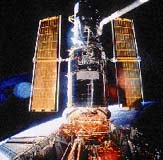
Baltimore MD (UPI) Oct 7, 2004 For the man in charge of what he calls the most innovative scientific facility in the world, the Hubble Space Telescope is no ordinary instrument for unlocking the secrets of the universe. It is an extension of the human eye, Steven Beckwith, the director of the Space Telescope Science Institute, told UPI's Space Watch. The images captured by that eye, Beckwith said, have touched the lives of millions in nearly every corner of the globe. That the Hubble is popular with people in different places and from different backgrounds is a fact to which he can personally attest. On a recent overseas trip, as Beckwith was riding aboard a Berlin-bound taxi, he and the driver struck up a conversation in German. Upon hearing that he was an astronomer by trade, the driver suddenly became animated. What is happening to the Hubble Space Telescope? the man asked him. Is it going to die? Not yet, Beckwith replied, but added it could not last more than a few years without a visit from NASA astronauts. Why, the driver continued, are the Americans so afraid that they don't want to fly to Hubble? The institute Beckwith has headed since 1998 is responsible for operating the Hubble Space Telescope as an international observatory, and the future prospects of the world's most famous telescope reflect much of the future of American astronomy. Beckwith has spent much of the past year in defense of the Hubble. He has been urging members of Congress to demand explanations for NASA Administrator Sean O'Keefe's controversial decision, last Jan. 16, to cancel a scheduled space shuttle servicing mission -- something that, if left to stand, will end the Hubble's nearly 15 years in orbit. His resulting struggle against O'Keefe's decision, which Beckwith described as being an advocate for another solution, has made him few friends at NASA headquarters. It did, however, help to draw normally cautious politicians and other leaders into the debate over the Hubble's future. At least one politician, Sen. Senator Barbara A. Mikulski, D-Md., converted Beckwith's advocacy and that of other scientists into a possible solution. She authored an emergency spending measure that added $300 million for a Hubble repair mission to NASA's fiscal year 2005 budget request. The measure was approved unanimously by the Senate Appropriations Committee last month, but failed to receive a vote by the full Senate before lawmakers left town for the fall election campaign. Mikulski's measure may receive a second chance at a vote when Congress returns Nov. 20 for a lame-duck, post-election session. I knew that the loss of Hubble would be devastating to astronomy, Beckwith said. That's why it was important that I become an advocate for another solution. From his office high atop the tree-lined campus of Johns Hopkins University, where the STScI is located, Beckwith directs about 500 employees. But it was not the size of the institute's work force that attracted Mikulski and others involved in the issue. It was because Hubble was a strong symbol to her of excellence in science, and of Baltimore's place as a center for astronomy in the world, he said. Beckwith has a far different view of a potential space shuttle mission to repair the Hubble than does O'Keefe, who he has never met and who has never attempted to contact him to discuss the Hubble issue. The risk in flying a shuttle mission (to repair Hubble) is minimal, Beckwith said. The remaining 25 or 30 shuttle flights to the International Space Station aren't any safer than one flight to Hubble. Beckwith acknowledged that O'Keefe has the greater responsibility for all of human spaceflight, and has the responsibility of answering directly to President George W. Bush regarding the president's new space exploration plan, which requires focusing shuttle missions on completion of the space station. Still, he said, the risk in attempting a Hubble repair mission is well worth undertaking, because of the telescope's value to astronomy and to the world. If NASA put out a call for people to fly the Hubble repair flight, then the agency would get 100 astronauts as volunteers, he predicted. Beckwith pointed to the Hubble missions as the type of space activity vital to the long-term U.S. space program. Repairing the telescope is the type of experience we need, he said. Currently, both NASA and Beckwith are awaiting the final recommendations of an independent review of the Hubble repair flight by a committee of the National Academy of Sciences. In a preliminary note to NASA this summer, the committee urged O'Keefe to keep the shuttle option alive until they completed their review, which should be soon. Though he acknowledged the need to wait for the report, Beckwith suggested that NASA be bold in its thinking. Leaders must make trade-offs in their decisions, he said. Fixing Hubble would be more noble an exercise than just finishing the ISS. O'Keefe has pointed to the need to use the space station as a safe haven, in the event of a shuttle becoming damaged during launch -- something not possible during a Hubble mission. But Beckwith said the concept was not mentioned in the report in 2003 by the Columbia Accident Investigation Board, even though the document is being used by NASA and O'Keefe as their Bible in readying the shuttle for its return. It's something that (O'Keefe) created, Beckwith said. O'Keefe has acknowledged as much, telling UPI's Space Watch last summer that the safe-haven, shuttle-rescue concept was and is a judgment call. So far, he has stood behind the decision to cancel the shuttle flight to the Hubble, and continues to support plans for a possible robotic repair mission. His agency recently awarded preliminary contracts to Lockheed Martin to develop an all-robot ship in case the decision to go is made next year. Still, Beckwith's strong advocacy of using a shuttle mission to repair the Hubble continues to draw fire from NASA. My own advocacy put me at some risk, he said, but I believe that I made the right choice in taking this position. Beckwith, who first became interested in science and math when he fished a high school physics textbook out of a garbage can as a youth, sees growing support in the United States for strong science education. Some cultures value science and technology more than others, he said. The Hubble has helped to focus students and their parents alike on astronomy and space as never before. He has seen Hubble posters even in English classrooms at high schools he has visited, a testament to the telescope's power in conveying the importance of science in its stunning images. On a recent trip abroad, as his passport was being checked at the airport ticket counter, the clerk look up at Beckwith and asked, are you a scientist? When the clerk learned what he did for a living, he smiled at Beckwith. You astronomers are so lucky, the woman said. You live among the stars -- not among the people. All rights reserved. Copyright 2004 by United Press International. Sections of the information displayed on this page (dispatches, photographs, logos) are protected by intellectual property rights owned by United Press International. As a consequence, you may not copy, reproduce, modify, transmit, publish, display or in any way commercially exploit any of the content of this section without the prior written consent of by United Press International. Community Email This Article Comment On This Article Related Links SpaceDaily Search SpaceDaily Subscribe To SpaceDaily Express Space Telescope News and Technology at Skynightly.com
 Carl Zeiss And Max Planck Researchers Develop Optical Technology For JWST
 Heidelberg, Germany (SPX) Dec 09, 2005
Carl Zeiss Optronics, in Oberkochen, Germany, and the Max Planck Institute for Astronomy in Heidelberg (MPIA), are developing the main fine mechanical optical technology for two instruments to be part of the James Webb Space Telescope (JWST).
--------------------------------------------------------- It's new. And it's downright terrific! Celestron's CPC Schmidt-Cassegrain telescope is the scope you've been waiting for! It offers new alignment technology, advanced engineering, and bold new design at a new, low price! In fact, Celestron's Professional Computerized (CPC) scope with revolutionary SkyAlign Alignment Technology redefines everything that amateur astronomers are looking for. It offers quick and simple alignment, GPS technology, unsurpassed optical quality, ease of use, advanced ergonomics, enhanced computerization and, most important, affordability. Want to view M-31 tonight? One button takes you there!
Shop for telescopes online at Telescopes.com! today!
|
|
|

| The content herein, unless otherwise known to be public domain, are Copyright 1995-2006 - SpaceDaily.AFP and UPI Wire Stories are copyright Agence France-Presse and United Press International. ESA PortalReports are copyright European Space Agency. All NASA sourced material is public domain. Additionalcopyrights may apply in whole or part to other bona fide parties. Advertising does not imply endorsement,agreement or approval of any opinions, statements or information provided by SpaceDaily on any Web page published or hosted by SpaceDaily. Privacy Statement |