|
 |
 |
 |
 |
 |
 |
 |
 |

 |
Space Vegetables Due In March
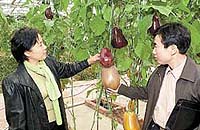
Beijing (XNA) Jan 07, 2005 The first space vegetables cultivated by Shenzhen Nongke Group Corporation (SNGC) are expected to become common dishes on city dining tables by March. On September 27 last year, 17 species of vegetable, fruit and flora seeds, chosen by SNGC, were sent into space with the country's 20th recoverable science satellite, which returned to Earth 18 days later. "Under the physical conditions of outer space, such as radiation, low gravity and vacuum, the seeds can take on astronautical mutagenesis, which alters the germ plasma of crop seeds," said SNGC's associate researcher Jin Xing. "After the satellite returned to Earth, the most high yielding and immunized seeds were selected," Jin said. "Different from genetically modified crops, which have evoked much controversy among scientists, no new genes are introduced to the space vegetables, so they are safe for consumption," Jin said. Space vegetables are now being planted in Shenzhen Outer Space Crops Park, on the western side of Honey Lake Road in Futian District, with a total area of 40,000 square meters. Established Oct. 29 last year as the breeding base of the Chinese Academy of Sciences, the park now has more than 50 species of space crops, including the 17 species from the city. "We're considering holding a tomato festival this March, by which time city residents will be able to enjoy about 30 varieties of space tomatoes on their dining tables," said the park's manager Li Sha'ai. Following the tomato festival, the other species of space vegetables in the park, such as cucumber, pepper, eggplant, tomato, bean, potato and pumpkin, would also go to market, with prices 30 to 50 percent higher than their common counterparts, Li said. So far, the Chinese Academy of Sciences has set up three space vegetable breeding bases, one of which is in Shenzhen, while the others are in Beijing and Jiangsu Province. Since 1987, the country has sent about 1,000 species of crop seeds into space on more than 10 recoverable science satellites. China, Russia and the United States are the only three countries with recoverable satellites trying out astronautical mutagenetic breeding technology. Source: Xinhua News Agency Community Email This Article Comment On This Article Related Links SpaceDaily Search SpaceDaily Subscribe To SpaceDaily Express The Chinese Space Program - News, Policy and Technology China News from SinoDaily.com
 Taikonauts On Moon A Far Off Dream For China Yet
 Beijing (XNA) Jan 05, 2006
A one-year lunar fly-by mission may start in April 2007 in China, but a manned flight to the Earth's neighbour may be a long way away, a chief lunar exploration scientist said last night. |
|
|

| The content herein, unless otherwise known to be public domain, are Copyright 1995-2006 - SpaceDaily.AFP and UPI Wire Stories are copyright Agence France-Presse and United Press International. ESA PortalReports are copyright European Space Agency. All NASA sourced material is public domain. Additionalcopyrights may apply in whole or part to other bona fide parties. Advertising does not imply endorsement,agreement or approval of any opinions, statements or information provided by SpaceDaily on any Web page published or hosted by SpaceDaily. Privacy Statement |