
 |
 |
 |
 |
 |
 |
 |
 |
 |

 |
Space: The Not-So-Final Frontier
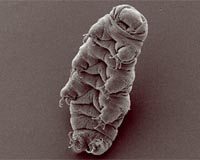
Boston MA (SPX) Sep 10, 2008 Of all environments, space must be the most hostile: It is freezing cold, close to absolute zero, there is a vacuum, so no oxygen, and the amount of lethal radiation from stars is very high. This is why humans need to be carefully protected when they enter this environment. New research by Ingemar Jonsson and colleagues published in the current issue of Current Biology, a Cell Press journal, shows that some animals -the so-called tardigrades or 'water-bears'- are able to do away with space suits and can survive exposure to open-space vacuum, cold and radiation. This is the first time that any animal has been tested for survival under open-space conditions. The test subjects were chosen with great care: Tardigrades -also known as water-bears- are tiny invertebrate animals from 0.1 to 1.5mm in size that can be easily found on wet lichens and mosses. Because their homes often fall dry, tardigrades are very resistant to drying out and can resurrect after years of dryness. Along with this amazing survival trick comes extreme resistance to heat, cold and radiation -so tardigrades seemed like an ideal animal to test in space. The dried-up tardigrades were aboard the FOTON-M3 spacecraft launched by the European Space Agency (ESA) in September 2007 and were exposed to open space conditions -i.e. to vacuum, UV radiation from the sun and cosmic radiation- in a low Earth orbit of around 270km altitude. After their safe return to Earth, it turned out that while most of them survived exposure to vacuum and cosmic rays alone, some had even survived the exposure to the deadly levels of solar UV radiation, which are more than 1000 times higher than on the surface of the Earth. Even more so, the survivors could reproduce fine after their space trip. The tardigrades extreme resistance to UV radiation is perhaps most surprising. UV rays consist of high-energy light particles that cause severe damage to tissue, as is evident when you get a sun-burn. But more so, they can also damage the cell's genetic material, causing for instance skin cancers. For this reason UV is deadly for most organisms -it is even used as a sterilising agent. As Jonsson and colleagues write: "How these animals were capable of reviving their body after receiving a dose of UV radiation of more than 7000 kJm-2 under space vacuum conditions [...] remains a mystery." It is conceivable that the same cellular adaptations that let them survive drying out might also account for their overall hardiness. Community Email This Article Comment On This Article Share This Article With Planet Earth
Related Links Current Biology Space Tourism, Space Transport and Space Exploration News
 Astronaut named head of Canadian Space Agency
 Ottawa (AFP) Sept 2, 2008
Astronaut Steve MacLean was appointed president of the Canadian Space Agency on Tuesday as the nation prepares for a new era of space exploration, Industry Minister Jim Prentice announced. |
|
|

| The content herein, unless otherwise known to be public domain, are Copyright 1995-2007 - SpaceDaily.AFP and UPI Wire Stories are copyright Agence France-Presse and United Press International. ESA Portal Reports are copyright European Space Agency. All NASA sourced material is public domain. Additional copyrights may apply in whole or part to other bona fide parties. Advertising does not imply endorsement,agreement or approval of any opinions, statements or information provided by SpaceDaily on any Web page published or hosted by SpaceDaily. Privacy Statement |
 del.icio.us
 Digg
Digg Reddit
 YahooMyWeb
 Google
 Facebook