|
 |
 |
 |
 |
 |
 |
 |
 |

 |
Space Telescopes Sharpen View Of Deep Impact Target
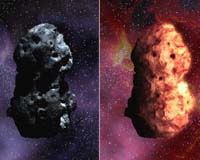
College Park MD (SPX) Jun 06, 2005 On July 4th, the University of Maryland-led NASA mission known as Deep Impact will get its one and only shot at its target, comet Tempel 1. Maryland astronomer Michael A'Hearn and his mission colleagues anticipate a hit on the comet that will knock out some of its "stuffing" for all the world to see. Some of their preparations for hitting Tempel 1 are built on key observations of the comet by two of NASA's "eyes in the sky" -- the Spitzer Space Telescope and Hubble Space Telescope. Early in 2004, nearly a year before the mission launched, the Great Observatories studied comet Tempel 1 and together came up with the best assessments of the comet's size, shape, reflectivity and rotation rate. "Spitzer was crucial in pinning down the comet's size, and the combination of Spitzer and Hubble was vital to learning its reflectivity and rotation rate," said A'Hearn, leader of the Deep Impact mission and principal investigator for the Spitzer and Hubble observations. "These are important findings that should help Deep Impact collide with its target and show us what this comet is made of."
New Light On A Cold Dark Object Previous observations of Tempel 1 taken with ground-based telescopes showed that the comet is dark and oblong, with a width of about a few kilometers. Spitzer and Hubble refined these measurements, revealing a deep black comet that is probably about 14 by 4 kilometers (8.7 by 2.5 miles), or roughly one-half the size of Manhattan. "Even tiny adjustments to our model of Tempel 1 are crucial to hitting the target and setting camera exposure times," said Carey Lisse, Johns Hopkins University, Baltimore, Md., lead author of a June 1 Astrophysical Journal Letters paper on the Spitzer observations of Tempel 1. The Deep Impact spacecraft was launched in January of 2005. Its mission is to study the primordial soup of our solar system, which is sealed away inside comets. Early on July 3, some 24 hours before impact, the Deep Impact spacecraft will separate into two parts. One part -- the impactor -- will place itself in the path of the dusty snowball. The second half -- the fly-by spacecraft -- will maneuver out of harm's way and slow its speed so that at impact it will have a prime, but relatively safe, viewing position to the side and front of the comet. After the impactor spacecraft is released, its specialized autonavigation software will steer it toward the sunlit portion of Tempel 1's core, or nucleus. To program this software, mission planners needed to know how big and reflective Tempel 1's surface is. Since its surface can't be observed directly from Earth, scientists first turned to Spitzer's infrared eyes to measure its size. When viewing a comet in visible light from very far away, only reflected sunlight can be seen, so a big, dark comet can look the same as a highly reflective, small comet. In infrared light, a comet's radiated heat is measured, providing a direct look at its size. Once the size of Tempel 1 was known, the scientists were able to calculate how reflective its surface must be in order to produce the amount of reflected, visible light observed by Hubble. They found that Tempel 1 reflects only four percent of the sunlight that falls on it. "Knowing the reflectivity also tells us how to set up our cameras," added Lisse. "Like photographers, it's important for us to know our subject before the shoot." Tempel 1's shape and rotation rate (about 2 days) were derived from long-term observations made by various telescopes, including Hubble, Spitzer and the University of Hawaii's 2.2-meter telescope at Mauna Kea. In addition to Deep Impact, at least 30 other telescopes around the world, including Spitzer, Hubble and the Chandra X-ray Observatory, will be watching the dramatic cometary impact. By carefully analyzing the material that is blown out of the interior of the comet, this global network of telescopes will assemble a list of the raw ingredients that went into making the planets in our solar system. The overall Deep Impact mission management for this NASA Discovery class program is conducted by the University of Maryland in College Park, Md. Deep Impact project management is handled by the Jet Propulsion Laboratory in Pasadena, Calif. The spacecraft was built for NASA by Ball Aerospace & Technologies Corporation, Boulder, Colo. Community Email This Article Comment On This Article Related Links Deep Impact at UMD Deep Impact at JPL SpaceDaily Search SpaceDaily Subscribe To SpaceDaily Express Asteroid and Comet Mission News, Science and Technology
 NASA'S Spitzer Finds Possible Comet Dust Around Dead Star
 Pasadena CA (SPX) Jan 12, 2006
NASA's Spitzer Space Telescope has spotted what may be comet dust sprinkled around the white dwarf star G29-38, which died approximately 500 million years ago.
--------------------------------------------------------- It's new. And it's downright terrific! Celestron's CPC Schmidt-Cassegrain telescope is the scope you've been waiting for! It offers new alignment technology, advanced engineering, and bold new design at a new, low price! In fact, Celestron's Professional Computerized (CPC) scope with revolutionary SkyAlign Alignment Technology redefines everything that amateur astronomers are looking for. It offers quick and simple alignment, GPS technology, unsurpassed optical quality, ease of use, advanced ergonomics, enhanced computerization and, most important, affordability. Want to view M-31 tonight? One button takes you there!
Shop for telescopes online at Telescopes.com! today!
|
|
|

| The content herein, unless otherwise known to be public domain, are Copyright 1995-2006 - SpaceDaily.AFP and UPI Wire Stories are copyright Agence France-Presse and United Press International. ESA PortalReports are copyright European Space Agency. All NASA sourced material is public domain. Additionalcopyrights may apply in whole or part to other bona fide parties. Advertising does not imply endorsement,agreement or approval of any opinions, statements or information provided by SpaceDaily on any Web page published or hosted by SpaceDaily. Privacy Statement |