|
 |
 |
 |
 |
 |
 |
 |
 |

 |
Space Technology Competes On Europe's Racetracks Again
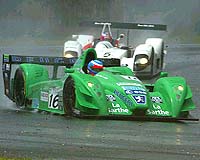
Paris (ESA) Apr 29, 2004 As the 2004 motor-racing season gets underway, technology from Europe's satellites and launchers is being put to the test on Europe's race tracks. Henri Pescarolo is again using light space composite materials to reduce the overall weight of his cars, as well as high-temperature insulation fabrics from Europe's launcher Ariane to increase safety. Why does ESA try out their advanced technologies in automobile racing? "Technological improvements are needed to make automobiles still more safe, reliable and comfortable," says Pierre Brisson, Head of ESA's Technology Transfer and Promotion Office, "and our exotic space technologies have already proven to be able to provide innovative and very solid solutions on Earth." "We started the cooperation with Henri Pescarolo two years ago to demonstrate how space technology can provide innovative solutions for endurance racing," explains Brisson. "Together we identified several areas where space technologies could improve race performance, safety aspects and driver comfort." Pescarolo Sport concluded the 2003 race season well, with their space-technology enhanced cars: they won two FIA Sportscar Championship races, came second in another, and finished eighth and ninth position in the legendary 24-hour Le Mans race out of 50 competitors. Presenting his new car for this season, Pescarolo-Judd, to the press in Paris last week Henri Pescarolo said, "Based on our good experience last year, we have chosen to continue with the same sophisticated materials from space." "The major change is that this year we use a V10 5 litre Judd engine. The body is basically the same, but we have further improved the aerodynamics. Weight has been reduced by the use of space composite materials from ESA and we are still using the special insulation materials, also from ESA, to reduce heat diffusion."
Good Start To The 2004 Season "Rather reassuring!" Concluded Henri Pescarolo after the two trial days, "I am convinced that with the right tires and adequate adjustments, we would have driven as quickly as Audi."
Space Technologies Onboard Pescarolo-Judd Car Andr� de Cortanze, Technical Director of Pescarolo Sport, emphasised the importance of weight by saying, "Performance to weight ratio is vital in racing. Having a lighter body with space materials makes it possible for us to optimise weight distribution, resulting in an improved overall performance." Insulation materials from the European Ariane launcher are used to limit heat transmission from engine and exhaust system to petrol tank and drivers cockpit. "Cooperating with Henri Pescarolo we can put our technologies under extreme stress in an automobile environment. Once they have confirmed their worth in tough races like Le Mans and Paris-Dakar, they will find their way into the mass-produced cars we all use every day, enhancing comfort and reliability, and more importantly, contributing to greater overall safety on our roads" concluded Brisson at the press conference. Pescarolo's space-material-enhanced racing car will compete in all four 1,000 km Le Mans Endurance Series races and at Le Mans 24-hour race. The first challenge is at the Monza racetrack 8-9 May. Community Email This Article Comment On This Article Related Links Pescarolo Sport ESA Technology Transfer Programme ESA Technology Transfer -- Cars and Trucks SpaceDaily Search SpaceDaily Subscribe To SpaceDaily Express Space Technology News - Applications and Research
 Industry Team Achieve New Communications Technology With AESA Radars
 Baltimore MD (SPX) Jan 12, 2006
A team comprised of three leading US aerospace and defense contractors has demonstrated an innovative technological use of active electronically scanned array (AESA) radars for high-bandwidth communications. |
|
|

| The content herein, unless otherwise known to be public domain, are Copyright 1995-2006 - SpaceDaily.AFP and UPI Wire Stories are copyright Agence France-Presse and United Press International. ESA PortalReports are copyright European Space Agency. All NASA sourced material is public domain. Additionalcopyrights may apply in whole or part to other bona fide parties. Advertising does not imply endorsement,agreement or approval of any opinions, statements or information provided by SpaceDaily on any Web page published or hosted by SpaceDaily. Privacy Statement |