|
 |
 |
 |
 |
 |
 |
 |
 |

 |
Space Technology Benefits Medical Community
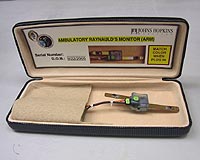
Baltimore MD (SPX) Feb 01, 2007 A small group of APL researchers, in collaboration with physicians from the Johns Hopkins Scleroderma Center in Baltimore, developed and recently completed initial trials for a miniature device to help physicians characterize Raynaud's disease and measure treatment effectiveness. "The Ambulatory Raynaud's Monitor is a tiny, Band-Aid-like device that enables physicians to objectively characterize a patient's condition, determine its severity and measure symptoms in real time," says Dr. Frederick Wigley, director of the Hopkins Scleroderma Center and one of the country's leading scleroderma experts, who asked the Johns Hopkins University Applied Physics Laboratory (APL), in Laurel, Md., to develop the device after reading about APL's work developing miniature devices for spacecraft. "Until now, Raynaud's research has been crippled without such a device." The small, low-cost monitor wraps around a patient's finger and is secured with a bandage or medical tape. It contains two sensors that alternately record skin and ambient temperatures - indicators of surface blood flow - every 36 seconds. Interactive controls permit a patient to record the date and time of a suspected Raynaud's attack. A week's data is held by the monitor's electronics and is retained even if the device's power is unexpectedly interrupted. Physicians can easily download data into a computer or PDA (personal digital assistant). Software developed by APL enables physicians to quickly and easily display and plot data, which could be done during a patient's appointment to provide real-time feedback. The monitoring system's batteries store enough energy to operate for several months, and devices can be cleaned and reinitialized for use with multiple patients. Triggered by cold temperatures or stress, Raynaud's is characterized by numbness and coldness in the fingers, toes, ears and/or nose when blood vessels in those areas constrict during attacks. Insufficient blood flow near the skin's surface also causes patients to experience skin color changes and varying levels of discomfort. Limited blood flow to the extremities can potentially lead to permanent loss of function. Raynaud's can occur on its own, or be secondary to another condition, such as auto-immune disorders like scleroderma or lupus. The device recently underwent initial testing on patients with Raynaud's being treated at the Johns Hopkins Medical Institutions. Patients wore a monitor for one week in their homes, pressing an "event button" on the device to indicate when a Raynaud's event was occurring. The data - processed by APL engineers and evaluated by JHMI physicians - indicates Raynaud's events can be successfully identified. Patients said the devices are comfortable and easy to use. "The data from this preliminary study suggests that the monitor can help scientists and physicians learn more about Raynaud's phenomenon and help investigators evaluate the effectiveness of drugs being developed to treat this disease," says APL's Binh Le, one of the inventors of the device. Based on initial data, APL researchers have enhanced the monitor's design and are gearing up for the next round of trials at JHMI later this winter. In addition to monitoring Raynaud's patients, this platform technology could be used for an array of other medical or monitoring applications. The monitor could be modified to measure skin temperature of patients at risk for developing cardiovascular disease by tracking endothelial function (how small blood vessels regulate local blood flow to the tissues). Measuring skin temperature in various real-life situations may provide a noninvasive method to determine vascular responses in health and in various disease states. With appropriate modifications, this monitoring system could also be used to track other physiological parameters, such as pulse rate and blood pressure, and transmit the information to remote call centers. Athletes, for example, could wear it to help measure their physiological performance throughout exercise routines. Community Email This Article Comment On This Article Related Links Applied Physics Laboratory Advanced Medical Science For Earth and Beyond Explore The Ring World of Saturn and her moons Jupiter and its Moons The million outer planets of a star called Sol News Flash at Mercury
 Cassini Images Mammoth Cloud Engulfing Titan's North Pole
 Paris, France (ESA) Feb 02, 2007
A giant cloud half the size of the United States has been imaged on Saturn's moon Titan by the Cassini spacecraft. The cloud may be responsible for the material that fills the lakes discovered last year by Cassini's radar instrument. Cloaked by winter's shadow, this cloud has now come into view as winter turns to spring. The cloud extends down to 60 degrees north latitude, is roughly 2400 kilometers in diameter and engulfs almost the entire north pole of Titan. |
|
|

| The content herein, unless otherwise known to be public domain, are Copyright 1995-2006 - SpaceDaily.AFP and UPI Wire Stories are copyright Agence France-Presse and United Press International. ESA PortalReports are copyright European Space Agency. All NASA sourced material is public domain. Additionalcopyrights may apply in whole or part to other bona fide parties. Advertising does not imply endorsement,agreement or approval of any opinions, statements or information provided by SpaceDaily on any Web page published or hosted by SpaceDaily. Privacy Statement |