|
 |
 |
 |
 |
 |
 |
 |
 |

 |
Space Tech Captures Toxic Micro-Organisms
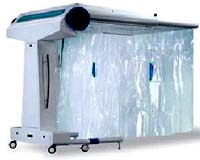
Paris (ESA) Jul 16, 2004 Sophisticated technology developed to ensure clean air for astronauts onboard space stations is now used in hospitals to capture and destroy airborne fungi, bacteria, spores and viruses. It can also eliminate microorganisms causing SARS, ebola, smallpox, and tuberculosis as well as anthrax. Most of the airborne micro-organisms around us do not present grave hazards to healthy people, however they can pose serious threats to those with reduced immune resistance. The space technology 'Plasmer' now provides an innovative solution to guarantee clean air in several European hospitals. Plasmer is a multistage system using strong electric fields and cold-plasma chambers to eliminate micro-organisms in the air. Using this space technology, the AirInSpace company with support from ESA's Technology Transfer and Promotion Office (TTP) has developed a transportable and protective unit for use in hospitals and emergency scenarios, providing an easy deployable clean room. "With the special Plasmer technology we have managed to develop an innovative solution to provide clean air by destroying more than 99.9% of micro-organisms, responding to the special needs of immune-compromised patients in hospitals," says Laurent Fullana, General Manager of AirInSpace. "Our system Immunair uses five Plasmer reactors to provide a clean-air 'tent', free of infective germs around a patient's bed. It is targeted primarily for immuno-haematology, oncology, reanimation and transplant hospital departments." "We have produced a smaller version, 'Cool Plasmair', with no 'tent', for use across a wide range of hospital areas where cross infection is a concern." Since early 2001 the system has been under test for a 12-month period in five hospitals. Dr Svetlana Challier, of the Necker Hospital in Paris, says, "Immunair makes it possible to reduce significantly the bacteria level in the air." Another user of the system, Professor Fran�ois Demeocq, CHU/H�tel-Dieu in Clermont-Ferrand, reports, "The biological protection with the Immunair system is very satisfactory and responds well to the needs required for children with strongly reduced immune defence following chemotherapy treatments. It could also be used to provide the protection after transplants." Demeocq adds, "For the children and their parents, this device is more convenient in everyday life and allows the emotional contact which is essential for these children who are isolated for a very long time." The Plasmer technology for the biological decontamination of air onboard manned spacecraft was invented in the early 90s by a group of Russian scientists. In 1997 the Russian space station MIR was equipped with Plasmer reactors successfully protecting cosmonauts and electronic equipment from bacteria, viruses and fungal contamination. In April 2001, Plasmer reactors were installed to clean the air from micro-organisms in the Russian segments on the International Space Station. Now the Plasmer space technology has moved down to Earth to protect immune-compromised patients in hospitals. Community Email This Article Comment On This Article Related Links AirInSpace SpaceDaily Search SpaceDaily Subscribe To SpaceDaily Express Space Medicine Technology and Systems
 Genomic Sequences Processed In Minutes, Rather Than Weeks
 Richland WA (SPX) Jun 22, 2005
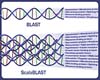
A new computational tool developed at the Department of Energy's Pacific Northwest National Laboratory is speeding up our understanding of the machinery of life - bringing us one step closer to curing diseases, finding safer ways to clean the environment and protecting the country against biological threats. |
|
|

| The content herein, unless otherwise known to be public domain, are Copyright 1995-2006 - SpaceDaily.AFP and UPI Wire Stories are copyright Agence France-Presse and United Press International. ESA PortalReports are copyright European Space Agency. All NASA sourced material is public domain. Additionalcopyrights may apply in whole or part to other bona fide parties. Advertising does not imply endorsement,agreement or approval of any opinions, statements or information provided by SpaceDaily on any Web page published or hosted by SpaceDaily. Privacy Statement |