|
 |
 |
 |
 |
 |
 |
 |
 |

 |
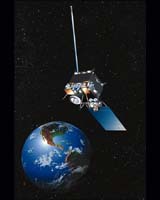
Space Systems Loral Completes GOES Weather Satellite Program
Palo Alto CA (SPX) Feb 14, 2007 Space Systems/Loral has completed satellite support operations for the Geostationary Operational Environmental Satellites (GOES) program, bringing to conclusion SS/L's successful satellite program that provided five advanced weather satellites and on-orbit services to the National Oceanic and Atmospheric Administration (NOAA). Space Systems/Loral is a subsidiary of Loral Space and Communications. The Geostationary Operational Environmental Satellites (GOES) I through M, which were built under contract to NASA Goddard Space Flight Center and launched between 1994 and 2001, have collectively outperformed their life expectancy by more than 55 percent, with two of the satellites still providing critical meteorological monitoring functions. In fulfilling the NASA contract, SS/L provided significant improvements over the previous GOES system in both weather imagery and atmospheric sounding information, allowing for improved weather services, including the forecasting of hurricanes and other severe storms that threaten life or property. Supporting the U.S. weather monitoring and forecast operations, the GOES satellites are a key component of NOAA's National Weather Service operations. "SS/L made a significant contribution to the international meteorological community with the GOES I-M program," said Martin A. Davis, NASA GOES program manager at the Goddard Space Flight Center. "The SS/L-built satellites continue to be a critical component to our National Weather Service operations and their longevity has given us additional leeway in our schedule to deploy next-generation systems."
Satellite Longevity Two of the five satellites were launched in 1994 and 1995 and provided 24-hour monitoring and measurement of dynamic weather events in real time. A third, launched in 1997, served as backup and provided added coverage of severe weather. A fourth, GOES-L, was launched in 2000, and the last in the series, GOES-M, was launched in 2001. As a demonstration of the reliability and robust design of the SS/L-built GOES satellites, GOES-11 (named GOES-L before launch) was put into service in May 2006 after being stored on the ground for two years and stored on-orbit for six years. SS/L partnered with ITT Space Systems Division to develop the GOES weather imaging and sounding systems, which were significantly improved over previous systems. During satellite operations, the imager and sounder in each satellite collect high-resolution visible and infrared images, as well as temperature and moisture profiles of the atmosphere. The satellites transmit data to ground terminals, which rebroadcast the information to primary weather services both in the United States and the western hemisphere. SS/L provided many breakthroughs in meteorological data collection with the GOES I-M program, including the following:
+ First 3-axis stabilized GOES series providing continuous earth imaging Community Email This Article Comment On This Article Related Links Weather News at TerraDaily.com Weather News at TerraDaily.com
 Northrop Grumman Checks Out Sensors On New Air Force Weather Satellite
 Baltimore, Feb 08, 2007
Five weather and space environmental sensors onboard the recently launched Defense Meteorological Satellite Program (DMSP) satellite, F-17, have been switched on and are operating successfully, according to Northrop Grumman Corporation (NYSE:NOC), the Air Force's DMSP sensor management contractor. |
|
|

| The content herein, unless otherwise known to be public domain, are Copyright 1995-2006 - SpaceDaily.AFP and UPI Wire Stories are copyright Agence France-Presse and United Press International. ESA PortalReports are copyright European Space Agency. All NASA sourced material is public domain. Additionalcopyrights may apply in whole or part to other bona fide parties. Advertising does not imply endorsement,agreement or approval of any opinions, statements or information provided by SpaceDaily on any Web page published or hosted by SpaceDaily. Privacy Statement |