|
 |
 |
 |
 |
 |
 |
 |
 |

 |
Space Scientists Uncover Causes Of Gap In Van Allen Belts
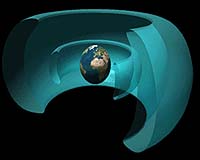
London UK (SPX) Sep 27, 2006 A team of British and US scientists have discovered that the gap in the Van Allen radiation belts is formed by natural wave turbulence in space, not by lightning. The discovery settles years of controversy among space scientists about the mechanisms responsible for causing the gap and has important implications for space weather forecasting. High above the Earth's atmosphere, energetic charged particles are trapped in the Earth's magnetic field where they form the Van Allen radiation belts. Energetic electrons, travelling close to the speed of light, occupy two doughnut shaped zones, usually separated by a gap known as the slot region. The underlying mechanism that clears the slot region of electrons has been the subject of intense scientific debate. Now, based on analysis of wave data collected over 13 months by the CRRES satellite, Dr Nigel Meredith of British Antarctic Survey and colleagues from BAS, the University of California, Los Angeles and the University of Iowa, believe that the gap is most likely formed by natural wave turbulence in space, rather than by lightning as the alternative theory suggests. Their results are published in the Journal of Geophysical Research this week. According to lead author, Dr Nigel Meredith: "Last year NASA scientists suggested that lightning-generated radio waves leaking out into space are responsible for the gap between the two belts by dumping particles into the atmosphere. Since lightning occurs far more often over land than water, waves in space should also occur more over land. "However, after analysing satellite data we found that there is no land-ocean variation at frequencies less than 1 kiloHertz where the waves are most intense. Instead, wave activity increases during geomagnetic disturbances driven by the Sun, suggesting that natural wave turbulence is responsible for the gap." "The results are important, because a better understanding of the radiation belts will help modellers forecast space weather more accurately, helping to protect both astronauts and satellites from radiation hazards." Community Email This Article Comment On This Article Related Links British Antarctic Survey Space Station News at Space-Travel.Com Space Tourism, Space Transport and Space Exploration News
 NASA Announces New Advisory Council Members
 Greenbelt Md (SPX) Sep 26, 2006
NASA Administrator Michael Griffin named nine new members to the NASA Advisory Council on Friday, including Dr. Edward David, Jr., Chair of the Science Committee, and Dr. Paul Robinson, Chair of the new Space Operations Committee. "These outstanding individuals will add to an already strong group and will greatly assist Chairman Schmitt in meeting the Council's goals," Griffin said. |
|
|

| The content herein, unless otherwise known to be public domain, are Copyright 1995-2006 - SpaceDaily.AFP and UPI Wire Stories are copyright Agence France-Presse and United Press International. ESA PortalReports are copyright European Space Agency. All NASA sourced material is public domain. Additionalcopyrights may apply in whole or part to other bona fide parties. Advertising does not imply endorsement,agreement or approval of any opinions, statements or information provided by SpaceDaily on any Web page published or hosted by SpaceDaily. Privacy Statement |