|
 |
 |
 |
 |
 |
 |
 |
 |

 |
Space Race 2: SpaceDev's Ride To Orbit
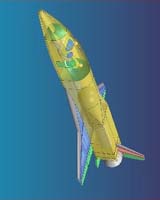
Cape Canaveral FL (UPI) Mar 01, 2005 When famed aerospace designer Burt Rutan was looking for a way to boost his fledgling spaceplane beyond Earth's atmosphere, a small company experimenting with hybrid rocket motors caught his eye. SpaceDev was not unknown in the industry - the company won a NASA-backed contract in 1999 from the University of California, Berkeley, to design, build and operate a science satellite called CHIPSat - but it for certain lacked the experience or reputation of rocket-motor behemoths such as Rocketdyne, Aerojet or ATK Thiokol. That suited a maverick like Rutan just fine. He wanted a rocket motor that would be safe to fly and cheap to buy. The liquid laughing-gas-and-rubber concoction SpaceDev created successfully catapulted the world's first privately developed spaceship more than 62 miles (100 kilometers) above the planet three times last year. The final two flights, which occurred just five days apart, clinched the $10-million Ansari X Prize for the SpaceShipOne team and signaled SpaceDev's arrival as a viable player in the nascent commercial space-transportation industry. SpaceDev, however, wants to do more than boost other companies' rocketships into space. It wants to be in the driver's seat as well. "We put our interest aside while we were working on the SpaceShipOne project, but we never really stopped working on it internally," James Benson, SpaceDev's founder and chief executive officer, told UPI's Space Race 2. Now, SpaceShipOne has been retired and there is no word yet if SpaceDev will be a player in the commercial version of the vehicle Rutan and his company are building for Virgin Atlantic's planned spaceliner fleet. So, Benson is turning his attention back to what originally captivated him about private space enterprise: developing low-cost access to space. The company has announced plans for a passenger spaceship called the Dream Chaser, based on the experimental hypersonic vehicles developed by NASA - such as the X-43A, which nearly reached Mach 10 in a test flight last November. The Dream Chaser will be able to fly to altitudes of about 100 miles (160 kilometers), powered by a single, high-performance hybrid rocket motor developed by SpaceDev. The motor will be designed to produce about six times the thrust of the motors developed for SpaceShipOne's flights. Dream Chaser is expected to debut as a reusable, piloted sub-orbital ship that can be scaled up to transport passengers to low-Earth orbit altitude, where the International Space Station flies and where a proposed commercial space hotel will be located. "Our interest has pretty much sky-rocketed to orbital - not sub-orbital - flight," Benson said, "but part of the testing for an orbital program includes sub-orbital flight." For Dream Chaser's body, SpaceDev is eyeing NASA's hypersonic X-34 vehicle, on which the agency stopped development in March 2001. The company last year signed an agreement to share and develop technical information with NASA's Ames Research Center in northern California, a pact that will give the firm access to design and test data on a fleet of prototype vehicles developed by the space agency, including the X-34. SpaceDev's agreement with Ames has no monetary value, but Benson has a long history of parlaying government and private contracts into technical expertise, products and services that suit his own interest. For example, the company has acquired a contract with the Department of Defense to build a small launch vehicle called the SpaceDev Streaker, using the company's hybrid rocket-motor technology. The Streaker's development is key to getting Dream Chaser off the ground. According to SpaceDev, a one-stage Streaker can be used as a target or sounding rocket. The three-stage version will be capable of launching micro-satellites from anywhere in the world on 24-hours' notice from aboard a C-17A cargo plane. A four-stage version can fly from a mobile ground launcher and carry 1,000 pounds into low-Earth orbit. "Basically, the Air Force is paying for development of one of the stages of the Dream Chaser," Benson said. "We're looking at the existing technology and then scaling it up. I think we're taking a practical, low-cost approach." It is a method Benson learned as an entrepreneur in the computing industry. He made millions in 1995 selling his software company located in the Washington, D.C., area, which he had developed into a major government contractor. Two years later, he founded SpaceDev, convinced that a smaller-is-better approach eventually would win favor ove r budget-busting government programs that were saddling space exploration and technology development. Benson said he thinks the industry is ripe for a personal-computing-type revolution to takeover what he calls the "mainframe" mindset of space programs today. He is happy to put his money where his mouth is, working under fixed-price contracts using proven, off-the-shelf products. In addition to its work on rocket motors, SpaceDev has a contract with the Air Force Research Lab to design and build an orbital transfer vehicle and space tug that can raise and lower satellites' orbits. The company also has an agreement worth up to $43 million over five years with the U.S. Missile Defense Agency to develop a network of micro-satellites. Benson's ambitions extend far beyond Earth orbit, however. His first commercial space proposal was to send a spacecraft to mine an asteroid for valuable minerals. Plans for the Near Earth Aste roid Prospector were shelved, but not forgotten. SpaceDev won a NASA study contract to design low-cost Mars missions and realized the same basic spacecraft blueprint it had created for the asteroid expedition could be used for nearly 20 different missions to locations ranging from Mercury to the main asteroid belt. In addition to science, SpaceDev craft could carry a mix of entertainment and engineering and even "novelty" payloads and be ready to launch in three-to-five years. All Benson needs is a customer. Space Race 2 is a weekly series exploring the people, passions and business of sub-orbital manned spaceflight, by long-time aerospace journalist Irene Klotz. E-mail: [email protected] Community Email This Article Comment On This Article Related Links SpaceDaily Search SpaceDaily Subscribe To SpaceDaily Express Space Tourism, Space Transport and Space Exploration News
 Spicing Up Space Meals
 Los Angeles CA (SPX) Jan 04, 2006
Since its launch a year and half ago, Minimus.biz has quickly become the place to go for individual and travel size items. Last week, NASA came to Minimus.biz and purchased several different travel size condiments to send with the astronauts to the International Space Station. |
|
|

| The content herein, unless otherwise known to be public domain, are Copyright 1995-2006 - SpaceDaily.AFP and UPI Wire Stories are copyright Agence France-Presse and United Press International. ESA PortalReports are copyright European Space Agency. All NASA sourced material is public domain. Additionalcopyrights may apply in whole or part to other bona fide parties. Advertising does not imply endorsement,agreement or approval of any opinions, statements or information provided by SpaceDaily on any Web page published or hosted by SpaceDaily. Privacy Statement |