|
 |
 |
 |
 |
 |
 |
 |
 |

 |
Space Probe Makes Final Descent Towards Saturn Moon
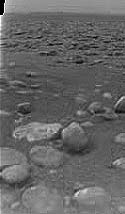
Darmstadt, Germany (AFP) Jan 14, 2005 A European robot lab parachuted to the surface of the Saturn moon Titan on Friday, successfully climaxing a venture to explore one of the most beguiling phenomena in the Solar System, mission leaders here said. Operating in the dark and friendless chill of deep space, the unmanned probe Huygens glided to Titan's surface, relaying its findings to its American mothership Cassini, which then sent the data home to NASA's waiting radio sentinels. Joy erupted at mission control as the precious data poured in. Scientists and space chiefs have bet more than three billion dollars on the Cassini-Huygens project and some have spent a quarter-century of their lives planning it and carrying it out. Huygens is "a scientific success ... and a fantastic success as well for international cooperation," the director-general of the European Space Agency (ESA), Jean-Jacques Dordain, declared. The probe headed to Titan's surface carrying half a dozen instruments within a clam-like shell to film and measure the moon's weather system and methane-rich atmosphere during a two-and-a-half-hour descent. Its sensors were designed to continue working for just three minutes after it landed on the bone-freezing Titan surface. But delighted scientists said the instruments probably continued to function for at least half an hour after touchdown, possibly providing vital clues as to whether Titan is covered by rock, methane ice or an ocean of chemicals. "I am sure we have at least 30 minutes of surface science," said Jean-Pierre Lebreton, head of the Huygens mission at ESA. Titan, the largest satellite of Saturn, was chosen for the 3.2-billion-dollar (2.46-billion-euro) transatlantic venture as, intriguingly, it is the only moon in the Solar System that has a substantial atmosphere. Its thick mix of nitrogen and methane is suspected to be undergoing chemical reactions similar to those that unfolded on Earth billions of years ago. That process eventually provided the conditions for life on our planet. "Titan is a time machine. It will especially provide us with the opportunity to know about the conditions on our early Earth," Alphonso Diaz, NASA Science assistant administrator, said. Huygen's descent, on a moon 1.5 billion kilometers (940 million miles) from home, was the farthest landing from Earth ever attempted. The operation was fraught with potential hitches, including the risk of a crash or catastrophic malfunction when the 319-kilo (702-pound) craft entered Titan's roiling atmosphere. Cassini had given Huygens a piggyback ride to Saturn and its moon system. Their epic seven-year trip, covering 2.1 billion kilometers (1.3 billion miles), culminated last July. Dordain described Friday's outcome as "a fantastic success for Europe, first of all for European industry which delivered a very complex machine. It worked beautifully with six scientific instruments, in a very harsh environment in order to break the secret of Titan." But it was also "a fantastic success as well for international cooperation," said Dordain. "We should learn lessons from this success. Lessons don't come only from failure." German Research Minister Edelgard Buhlman was equally overjoyed, hailing the mission as "one of the greatest events in space science and technology." The chemical processes believed to be unfolding on `Titan may give clues as to how life took root on Earth. But life -- or at least life as we understand it -- is unlikely to exist on Titan itself, given that it is so far from Sun, receiving negligible solar heat and light. The moon's surface temperature is estimated to be -180 Celsius (-292 Fahrenheit). After Friday's drama, Cassini will pursue its four-year mission map Saturn, the second largest planet of the Solar System, and its leading satellites. Huygens is named after the Dutch astronomer Christiaan Huygens, who discovered Titan in 1655. Cassini's name comes from the Italian Jean-Dominique Cassini (1625-1712), who discovered the Saturnian satellites Iapetus, Rhea, Tethys and Dione. In 1675, he discovered what is called the "Cassini Division," the gap between Saturn's rings.
earlier related report Mission controllers -- worried that the most ambitious interplanetary mission ever attempted would end disastrously -- shouted for joy when Huygens sent a radio signal, proving that it had survived the buffeting entry. "The baby is alive," exulted David Southwood, director of science at the European Space Agency (ESA). But he cautioned: "We still have a long way to go. The baby is out of the womb, but we still have to count the fingers and toes." The historic signal was picked up by the Green Bank listening station in West Virginia in the United States and by the Parks antenna in Australia's New South Wales. Claudio Solazzo, mission operations chief, said a clam-like shield was designed to protect Huygens from friction heat as it hurtled in from deep space at 20 times the speed of sound and collided with Titan's atmosphere. "The first thing will be the opening of one small parachute. Soon after that, the main parachute, eight metres (26 feet) wide, will open. After that, all the instruments will be [turned] on. It will be a clockwork process," Solazzo said. The 319-kilo (702-pound) craft's instruments were to film Titan's surface, measure wind speed and pressure and analyse atmospheric gases as it descended to the surface over two and a half hours. So little is known about Titan that it was unclear as to exactly when and where it would touch down. The site could be a hard surface of methane ice, or rock, or possibly a chemical sea. Whatever the circumstances, the instruments were designed to carry on monitoring for another three minutes. Only when data was to be received later Friday would anyone know whether the huge gamble has been a success, said Huygens scientist Leonid Gurvits. By 1800 GMT, "all data from the mission will have been acquired and released to the scientists, and scientific work can actually begin at this point," Solazzo said. Titan was chosen because it is the only moon in the Solar System that has a substantial atmosphere. Its thick mix of nitrogen and methane is suspected to be undergoing chemical reactions similar to those that unfolded on Earth billions of years ago. That process eventually provided the conditions for life on our planet. "Titan is a time machine. It will especially provide us with the opportunity to know about the conditions on our early Earth," Alphonso Diaz, NASA Science assistant administrator, told reporters at Huygens mission control, the European Space Operations Centre. The mission is conducted in tandem with the NASA orbiter Cassini, which gave Huygens a piggyback ride from Earth to Saturn, a voyage that began in 1997 and ended in their separation off Titan on December 25. Cassini circled overhead Firday in order to pick up data from Huygens and then relay it back to Earth. The transatlantic tie-up, costing 3.2 billion dollars (2.46 billion euros), "is another example of what cooperation means," said ESA Director-general Jean-Jacques Dordain. "It has been a tremendous 25 years of hard work for more than 200 scientists from 19 different countries." After the ambitious one-day Huygens mission, Cassini will continue a four-year survey of Saturn, the Solar System's largest planet after Jupiter. Huygens is named after the Dutch astronomer Christiaan Huygens, who discovered Titan in 1655. Cassini's name comes from the Italian Jean-Dominique Cassini (1625-1712), who discovered the Saturnian satellites Iapetus, Rhea, Tethys and Dione. In 1675, he discovered what is called the "Cassini Division," the gap between Saturn's rings. Community Email This Article Comment On This Article Related Links SpaceDaily Search SpaceDaily Subscribe To SpaceDaily Express Explore The Ring World of Saturn and her moons Jupiter and its Moons The million outer planets of a star called Sol News Flash at Mercury
 Cassini Images Halo Around Titanic Moon Off Saturn
 Pasadena CA (SPX) Dec 27, 2005
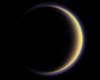
With its thick, distended atmosphere, Titan's orange globe shines softly, encircled by a thin halo of purple light-scattering haze. |
|
|

| The content herein, unless otherwise known to be public domain, are Copyright 1995-2006 - SpaceDaily.AFP and UPI Wire Stories are copyright Agence France-Presse and United Press International. ESA PortalReports are copyright European Space Agency. All NASA sourced material is public domain. Additionalcopyrights may apply in whole or part to other bona fide parties. Advertising does not imply endorsement,agreement or approval of any opinions, statements or information provided by SpaceDaily on any Web page published or hosted by SpaceDaily. Privacy Statement |