|
 |
 |
 |
 |
 |
 |
 |
 |

 |
Space Is Big, But Not Big Enough
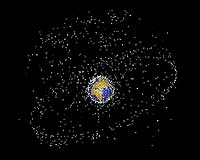
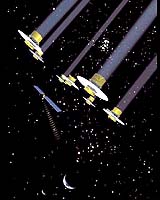
Paris (ESA) Sep 30, 2002 According to Douglas Adams, in his famous book The Hitch-Hikers Guide to the Galaxy, space is big. However, it seems near-Earth space is not big enough. In December 2001, the Space Shuttle pushed the International Space Station away from a discarded Russian rocket booster that was due to pass uncomfortably close. Space litter is a growing problem but smarter satellite design may help in the future. From the beginning of the space era, satellites and deep-space probes have populated the Solar System. There are now a huge number of satellites orbiting the Earth, for different purposes including Earth observations, weather forecasting, telecommunications, military applications, and astronomy. The space around Earth is therefore becoming more and more crowded. Aside from the aspect of 'space traffic control', there is the question of what to do with space litter. ESA's European Space Operations Centre (ESOC) in Darmstadt, Germany, tracks space litter. It estimates that over 23,000 objects larger than 10 centimetres have been launched from Earth. Of these, about 7500 are still orbiting -- only a very small proportion of them (6%) is operational. Half of all the objects are inoperable satellites, spent rocket stages, or other large space litter; the remaining 44% is debris from explosions and accidents in space. To make things worse, there are an estimated 70,000 to 120,000 fragments smaller than 1 centimetre and the amount of space debris increases by about 5% every year. Tiny fragments, such as paint flecks, moving at very high velocities of around 6 kilometres per second can create problems for the spacecraft and for astronaut. One way to lower the threat is to remove satellites from orbit at the end of their working lives. If we force satellites down through the Earth's atmosphere, they burn up. However, this is more complicated if the satellite is so large that parts of it are liable to survive reentry and strike the ground. This is the case for some Earth observation satellites, for example, which are very big and heavy. When removing a (dead) satellite from orbit is too difficult, it is simply left in orbit. However ESA is developing a new technology for its Darwin mission. This technology may allow smaller, more easily disposable satellites to replace often enormous relics in the future which would improve spacecraft control. Darwin will use a flotilla of six 2-metre-diameter telescopes, flying in tight formation, to simulate a single telescope up to 250 metres across. The new technology being developed for Darwin allows the flotilla of spacecraft to control their mutual position with extremely high accuracy.

|