|
 |
 |
 |
 |
 |
 |
 |
 |

 |
Space In 2004: Robots Versus The Right Stuff
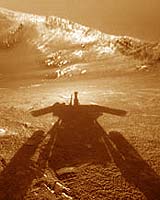
Paris (AFP) Dec 12, 2004 From the Moon and Mars to the satellites of Saturn and the cold, dark depths of the Solar System, robots have been the big stars of space exploration this year. Manned missions were deep in the doldrums, yielding the headlines to a small force of unmanned probes and landers. The three surviving craft in US space shuttle fleet remained grounded, overshadowed by the loss of Columbia in 2003. China chose not to add to its maiden manned mission of last year. Russia was too poor to more than send resupply missions to the International Space Station. And the ISS itself whirled uselessly around the Earth, serviced by a skeleton crew, its construction programme suspended by the shuttle disaster. In the place of humans, unmanned explorers proved their worth, relentlessly pushing the frontiers of knowledge, less glamorously but at a fraction of the expense and without risking a single life. In the Year of the Machine, these were the highlights: - MARS: The thick veil of mystery obscuring the Red Planet began to lift, thanks to the NASA rovers Spirit and Opportunity and the European orbiter Mars Express. Through them, we know that Mars' poles harbour water ice and its surface was once awash with water, the stuff of life. But where this precious ocean went remains one of the great puzzles of the Solar System. - SATURN: After a seven-year trek across 3.5 billion kilometersbillion miles), the US-European mission Cassini-Huygens arrived at the ringed giant in the middle of 2004 and is now sending back pictures of unprecedented detail and beauty. Next step: the dispatch of a probe to the mysterious Saturnian moon, Titan, which may hold chemical clues as to how life began on Earth. - MOON: Forlorn and forgotten, deemed a closed chapter of exploration after the last Apollo mission in 1972, Earth's satellite this year unleashed a surge of interest, among veteran spacefaring nations and newcomers alike. In the vanguard is the European Space Agency (ESA) probe SMART-1, a testbed of new technology, including an ion engine which could revolutionise interplanetary missions. SMART-1 is the first in a space flotilla planned in the coming years by China, India, Japan and the United States, which also plans a return to the Moon as a possible springboard for a manned mission to Mars. National pride is the big motive more than scientific research, but there is also new speculation that water may lie under the lunar surface, something that would help establish a human settlement. - COMETS: For the superstitious, comets are the harbingers of great events, good or evil. For scientists, they are primeval material left over from the building of the Solar System that could tell us how the planets were formed. Robot technology, patience and deep pockets are now putting the secrets of the comet within our grasp. This year, a US probe snatched particles of a cometary tail (the machine is due to return to Earth in 2006), and Europe launched Rosetta, an extraordinary 10-year venture to land on a comet in deep space and analyse its surface. Those who prefer human endeavour - "the right stuff," to use the title of Tom Wolfe's account of early manned space flight - should feel reassured. The shuttle is due to return to service in the first half of 2005; construction of the ISS will then resume, if all goes well; China is expected to carry out its second manned flight; and pioneering entrepreneurs, bolstered by the flight this year of SpaceShipOne, the first private spacecraft, will be setting plans to put tourists into orbit. But for all the derring-do, these flights will be in Earth's backyard - easy to get to and reassuringly close to home if anything goes wrong. If 2004 has been any guide, the future limits of space will be tested not by flesh and blood, but by metal and plastic. Community Email This Article Comment On This Article Related Links SpaceDaily Search SpaceDaily Subscribe To SpaceDaily Express All about the robots on Earth and beyond!
 Engineers Deliver Robot to Neutralize Remote Explosives
 Tyndall AFB (SPX) Jun 30, 2005
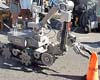
Engineers from the Air Force Research Laboratory Materials and Manufacturing Directorate have rapidly prototyped, developed, and delivered low-cost expendable robots to disable and dispose of improvised explosive devices. |
|
|

| The content herein, unless otherwise known to be public domain, are Copyright 1995-2006 - SpaceDaily.AFP and UPI Wire Stories are copyright Agence France-Presse and United Press International. ESA PortalReports are copyright European Space Agency. All NASA sourced material is public domain. Additionalcopyrights may apply in whole or part to other bona fide parties. Advertising does not imply endorsement,agreement or approval of any opinions, statements or information provided by SpaceDaily on any Web page published or hosted by SpaceDaily. Privacy Statement |