|
 |
 |
 |
 |
 |
 |
 |
 |

 |
Space Command Striving For Improved Field Communications
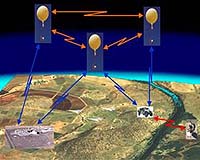
90th Space Wing Public Affairs F E Warren AFB WY (SPX) Nov 07, 2007 Members of Air Force Space Command's Space Innovation and Development Center were on hand in Warren's Quebec flight area recently but they weren't looking to the area's Peacekeeper past; they were demonstrating the future. "We're here to continue demonstrations of the Combat Airborne Network," said Maj. Jeffrey Zornes, U.S. Air Force Tactical Exploitation of National Capabilities, Commercial Integration Division deputy chief. "We're hoping to gather range and signal quality data to further this platform's opportunities in any [area of responsibility]." Development and initial operational checks were conducted in Colorado Springs, Colo., and Chandler, Ariz., but when it came to "kick the tires and light the fires," Warren got the nod to host the demonstration for many good reasons. "Warren's missile fields seemed ideal for the second round of demonstrations," said Maj. Zornes. "The landscape, weather patterns and sparse population help in the data gathering of quality information and provide a quiet environment for the demonstration." The areas' sparse population allows for more control of another demonstration variable -- interference from wireless communications signals. As anyone who's driven throughout Warren's missile complex knows, there are few cell phone relay antennas and plenty of dead spots with no wireless coverage. The system, which uses one or more high-altitude balloons, effectively becomes the communications link for ground forces and a command and control tool for strategists away from the front line. "We are excited to host a demonstration that highlights security forces applications in Warren's missile field," said 1st Lt. Andrew Pisut, 90th Communications Squadron. "During a mock SF response, this airborne wireless network will allow for greater command and control information to pass between the response team and the missile alert facility." In addition to voice and data, the SIDC hopes to demonstrate streaming video and platform survivability capabilities. "The more applications and abilities we can demonstrate with this system, the more beneficial it will be to those warfighters on the ground around the world," said Major Zornes. "With multiple balloons we can create a wireless mesh network that will automatically reroute the information to the clearest path, limiting degradation of the system due to jamming or destruction of a platform by the enemy." As Major Zornes and others involved with the program proceeded through the development of the CAN, they continued to look for applications in every aspect of operations. For Warren, they see increased situational awareness during convoy or security forces response operations, the elimination of communication "dead spots" and potentially a deployable emergency wireless network throughout the complex. The demonstration here should give the SIDC more concrete data on the system's abilities, and a better picture of the range and quality of the signal sent. With that information, they can continue to improve the system and grow its operational uses across the services. "This demonstration will go a long way to solidify the system," said Major Zornes. "And its success here is a great example of the Air Force's 'total force' concept working toward improving operations for all branches of service. "It takes all components of the Air Force to run a demonstration like thi, he said." Active duty, Guard, Reserve and Department of Defense civilians have all come together to work this project." Community Email This Article Comment On This Article Related Links Read the latest in Military Space Communications Technology at SpaceWar.com
 Lockheed Martin Completes Major Test Of First Advanced Military Communications Satellite
 Sunnyvale CA (SPX) Oct 31, 2007
Lockheed Martin has completed a major test of the first Advanced Extremely High Frequency (AEHF) satellite, demonstrating its readiness to enter the critical environmental test phase in preparation for launch in late 2008. The Advanced EHF system will provide global, highly secure, protected, survivable communications for all warfighters serving under the U.S. Department of Defense. |
|
|

| The content herein, unless otherwise known to be public domain, are Copyright 1995-2007 - SpaceDaily.AFP and UPI Wire Stories are copyright Agence France-Presse and United Press International. ESA Portal Reports are copyright European Space Agency. All NASA sourced material is public domain. Additional copyrights may apply in whole or part to other bona fide parties. Advertising does not imply endorsement,agreement or approval of any opinions, statements or information provided by SpaceDaily on any Web page published or hosted by SpaceDaily. Privacy Statement |